

Political and policy uncertainty can influence sentiment. The longer-term question is: can innovation convert to durable earnings growth?
The global debate around the United States is rarely quiet. Policy, trade and political tone can move markets, but the headlines can obscure a more durable feature: the country's ability to finance innovation, build companies around it and turn new technologies into commercial growth.
For advisors assessing U.S. equity exposure, the relevant question is whether that ecosystem continues to produce businesses capable of compounding earnings over time.
The U.S. Advantage Is an Ecosystem
U.S. innovation leadership reflects a connected system of research universities, venture capital, public markets, skilled labour, intellectual property and large end markets. Together, they can shorten the path from an idea to a scaled business.
Innovation becomes investable only when capital, customer adoption and management execution convert it into revenue, margins and cash flow. The depth of the U.S. market creates more opportunities to evaluate that process across established and emerging companies.
Market leadership will change, but the ecosystem continues to replenish the pool of potential leaders.
AI Illustrates the Scale of Investment
Artificial intelligence offers a particularly visible example. Private AI investment in the United States reached approximately US$285.9 billion in 2025, compared with US$12.4 billion in China, US$5.9 billion in the United Kingdom, US$4.36 billion in France and US$4.28 billion in Canada.
Spending alone does not determine future returns, nor will every AI-related company succeed. The figures do show the scale of capital directed toward infrastructure, software, models and applications across the U.S. economy.

Innovation Is Broader Than Technology
AI may dominate the current discussion, but innovation-led growth extends into health care, industrials, financial services and consumer businesses, where companies are applying new technologies to products, operations and customer relationships.
Recent earnings data reinforce that broader view. The seven mega-cap companies commonly grouped as the Magnificent 7 have accounted for a significant share of S&P 500 earnings growth in recent years. However, Q2 2026 results showed stronger participation beyond those market leaders.
With 97% of S&P 500 companies reported, the 493 companies outside the Magnificent 7 generated blended year-over-year earnings growth of 31.8%, their strongest result since Q4 2021. Magnificent 7 earnings grew by 118.5%, although investment-related valuation gains at Alphabet and Amazon significantly influenced that figure. Excluding those two companies, earnings growth for the remaining five was approximately 43.2%.
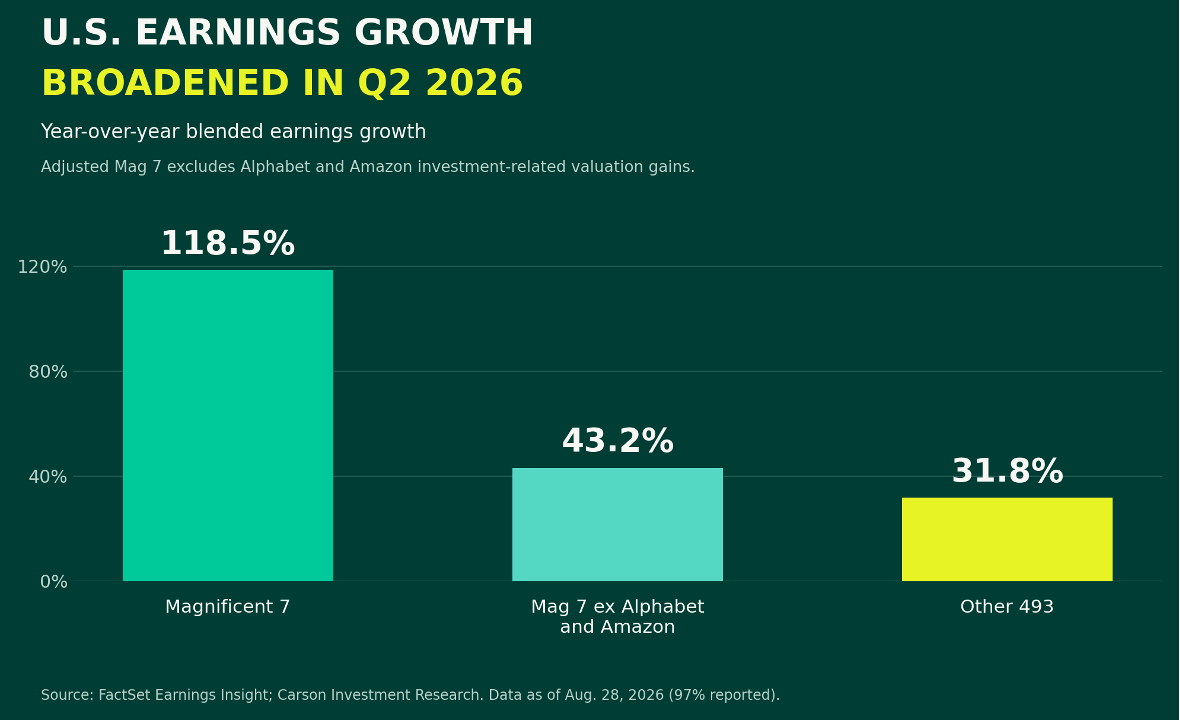
That breadth gives active investors room to look beyond familiar leaders and assess where product cycles, industry change or a favourable macro backdrop are strengthening company fundamentals.
From Innovation to Investable Growth
Innovation is a starting point, not an investment thesis. The task is finding companies that can convert a catalyst into durable, high-quality earnings growth.
That requires testing demand, competitive position, capital allocation and valuation. A compelling product can still be a poor investment if competition erodes its economics or the share price already discounts an optimistic outcome.
Fundamental research is especially important when enthusiasm concentrates around a popular theme. It can help distinguish essential infrastructure and defensible applications from businesses whose valuations depend on difficult-to-deliver growth.
Selectivity in a Concentrated Market
Since broad U.S. indexes are weighted by market capitalisation, strong performance among the largest companies has increased concentration. Benchmark weights reflect value already accumulated, not a forward-looking assessment of growth prospects or valuation.
This makes the distinction between owning the index and selecting individual companies more consequential. An active portfolio can size positions by conviction, reassess holdings as fundamentals change and redirect capital when a more attractive opportunity emerges.
The Ninepoint American Growth Fund (launching on October 14, 2026) applies that discipline through a focused portfolio of approximately 25 to 45 U.S. companies, weighted by conviction rather than benchmark composition. Each holding is tested against its fundamentals, valuation and available alternatives.
Looking Beyond the Noise
The U.S. market is not inexpensive in every area, and innovation does not eliminate business, valuation or market risk. Political and policy developments also affect individual industries and companies.
Short-term perceptions of the United States are not the same as the long-term economics of its leading businesses. Its combination of research capability, capital formation, entrepreneurial talent and corporate scale remains difficult to replicate.
For advisors, the more useful question is how U.S. growth exposure is built. Can the strategy look beyond the index's largest weights, distinguish durable earnings drivers from thematic enthusiasm, maintain valuation discipline when a theme becomes widely owned and redirect capital as the evidence changes?
The U.S. continues to produce innovative companies, but capturing that opportunity is unlikely to be as simple as owning the most visible names. A disciplined, research-intensive approach may help identify emerging leaders, avoid businesses whose expectations have moved ahead of fundamentals and allocate capital where growth, quality and valuation are better aligned. The process behind the portfolio may matter as much as the market itself.