
It's been a whirlwind of activities since I joined Ninepoint Partners just over a month ago. It's been a huge breath of fresh air working for a firm with great leadership, talented investment professionals, an energetic sales and marketing team, and staff who genuinely care about delivering a good investor experience. And I'm grateful to be working again with my trusted growth partners—Jonathan Lo and Sam Mitter.
What I've most enjoyed since coming back is getting time with clients again. I'm struck by how many different views are out there—it makes for fascinating conversations about where the markets are headed and what the macro-economic environment looks like. The one observation I can make is that there doesn't seem to be a consensus opinion other than the common broad brushstroke view of many investors being 'cautiously optimistic'.
I've always thought 'cautiously optimistic' is something of an oxymoron. After all, how can one be cautious and optimistic at the same time? With all of the headlines on risks ranging from geo-political uncertainty, to rising interest rates, to an AI overbuild, to the K-shaped recovery, to lofty stock market valuation levels, it is no wonder there is cautionary view. Perhaps it is better to think of a cautiously optimistic stance representing a balanced approach reflecting an expectation of market volatility and market returns still being attractive. It is a common observation to express the thought that one should expect the market to be volatile and hence warrant being cautious. Typically, this translates into the notion of there being downside risk in the market. That said, volatility is a calculation based on fluctuations in stock prices both on the upside and downside. Therein lies the conundrum since no one has ever called me to say 'the upside volatility in your stock picks is killing me'. And so, we come back full circle in that being cautiously optimistic reflects both the upside and downside stock prices exhibit over time with the upside dominating when it comes to market indices having positive returns over longer time periods.
My take is simpler: I'm optimistic about the stock market because I believe we're in a bull market. We're approaching the four-year anniversary of the low on October 13, 2022. Yes, there was a tariff-related correction of 21.3% in 2025, but it only lasted two months—similar in both size and duration to the 20.3% and 21.6% drawdowns we saw in 2018 and 2011. Those weren't bear markets either.
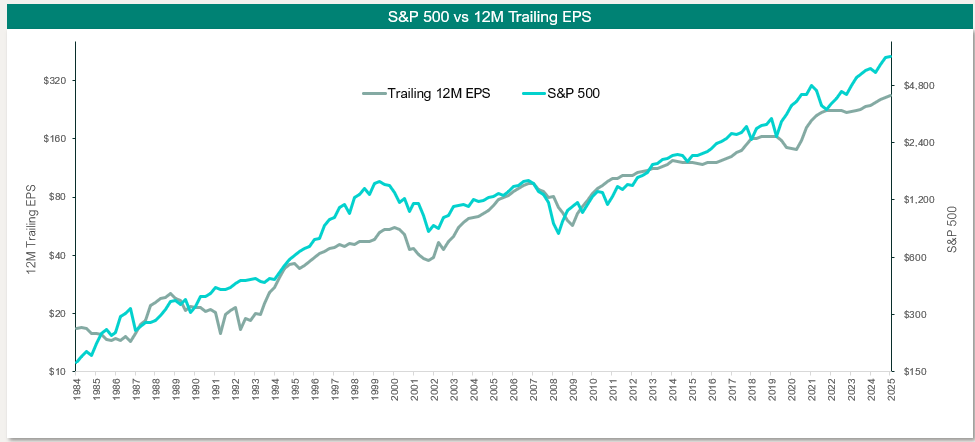
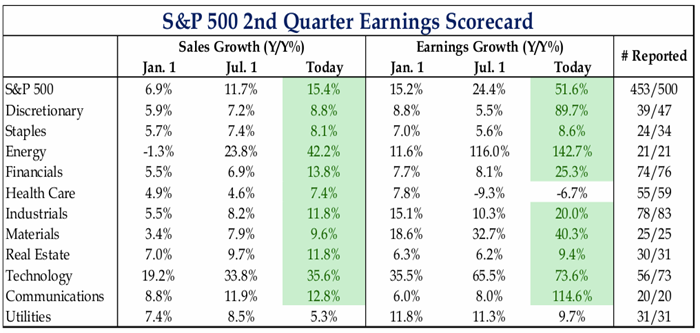
So why can markets keep climbing after three-plus years of solid returns? The answer is straightforward: earnings growth. It's the single best predictor of stock prices. As we've noted before, earnings growth in 2026 has been spectacular. With over 90% of the S&P 500 having reported earnings, earnings growth is tracking to a spectacular 51% growth rate, and even after excluding the investment write-ups from some of the hyperscalers, earnings growth is still north of 30%. Revenue growth is a very strong 15%, and while strength is coming from the AI boom, we're also seeing solid growth across a broad spectrum of companies. That's why equal-weight indices are holding up well—a bigger slice of the market is doing its part. This kind of rotation across sectors and market caps should continue to support higher stock prices.
Figure 1 – Earnings the Most Correlated Factor (LHS), S&P 500 Q2 Earnings Scorecard (RHS)
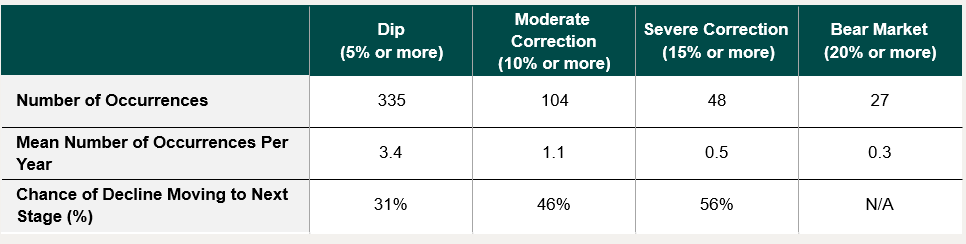
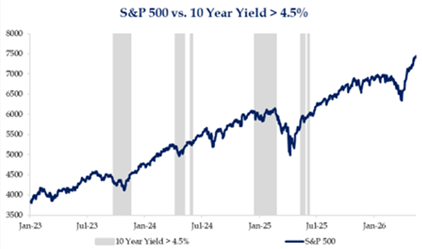
The outlook for further profit growth is encouraging since there's no recession in sight. Inflation has remained higher than central banks prefer, which is why interest rates have trended higher despite some softening in consumer prices. That's prompted some concern about a significant market correction. But corrections during an uptrend should be fully expected—they've been a regular occurrence over the last hundred years of market history. We've already experienced a 10% and a 5% correction in 2026, which aligns with what history tells us to expect. The table and graph below show the frequency of market corrections and how moves in the 10-year Treasury yield above 4.5% can be a source of market weakness.
Figure 2 – Corrections are Normal (LHS), S&P 500 and 10 Year Yield Above 4.5% (RHS)
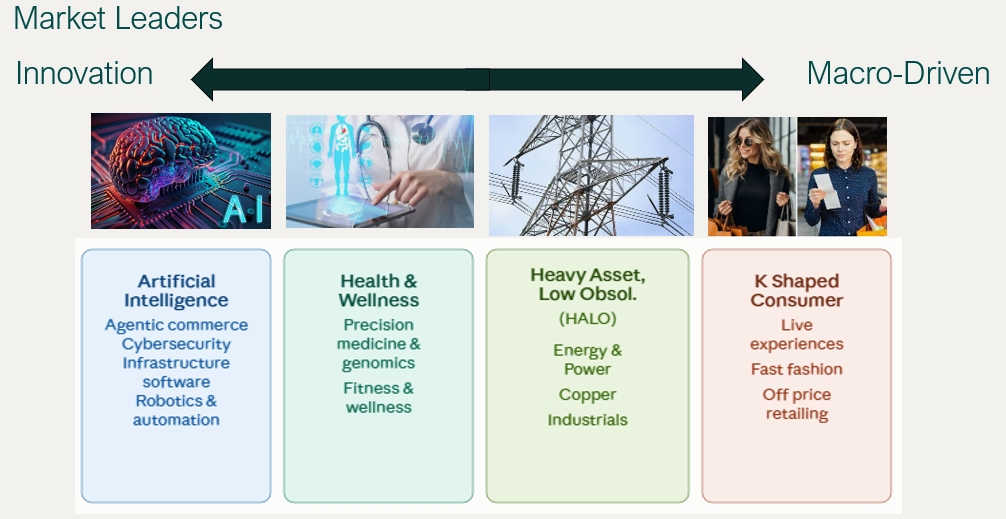
While we need to come up for air from the onslaught of corporate news from second quarter results and digesting all the developments which may move the market, we continue to focus on managing the portfolio to ensure exposure to market leaders. Market leadership is driven, as we see it, by two factors: innovation and the macro-economic environment. Think of these two factors as having an abundance of oxygen fueling the beneficiaries of these factors to have healthy outlooks. Listed below are some themes which we have represented in our portfolio with securities which we believe will benefit from a better than consensus outlook. Themes and the related securities change over time and we too, with our white sheet of paper approach, have the flexibility to react to the changing landscape of opportunities. That said, sometimes it's just best to take a deep breath, sigh and let your investment philosophy and process that has worked in the past take its course.
Figure 3 – Investment Themes
Have a great week!
Tony, Sam & JLO