ADVISOR USE ONLY
Beyond the Picks & Shovels
For the past two and a half years, playing the artificial intelligence (AI) theme has been an exercise in identifying the ultimate picks-and-shovels beneficiaries: semis, semiconductor fabrication, and massive power generation projects. Everything else in tech risked being labeled as vulnerable to disruption. But as the saying goes, a funny thing happened on the way to the forum. As the dust settles on the latest round of corporate results, a new narrative has quietly taken shape. The massive wave of capital expenditure is no longer stopping exclusively at the picks and shovels; it is now washing downstream. As software results rolled in over recent weeks, a clear pattern has started to emerge: infrastructure software companies are beginning to capture the tangible monetization of AI workloads.
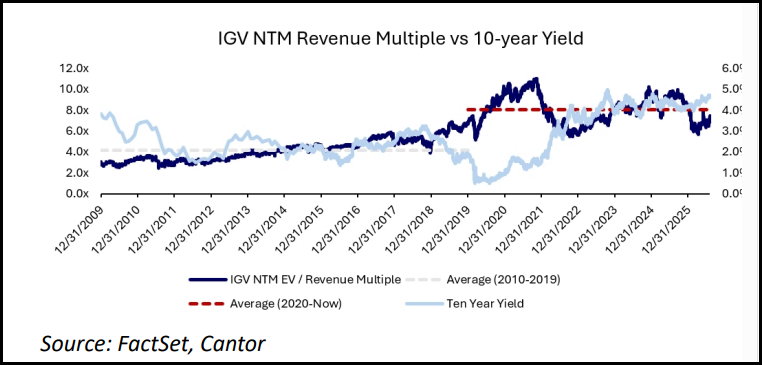
Figure 1 – IGV Revenue Multiple
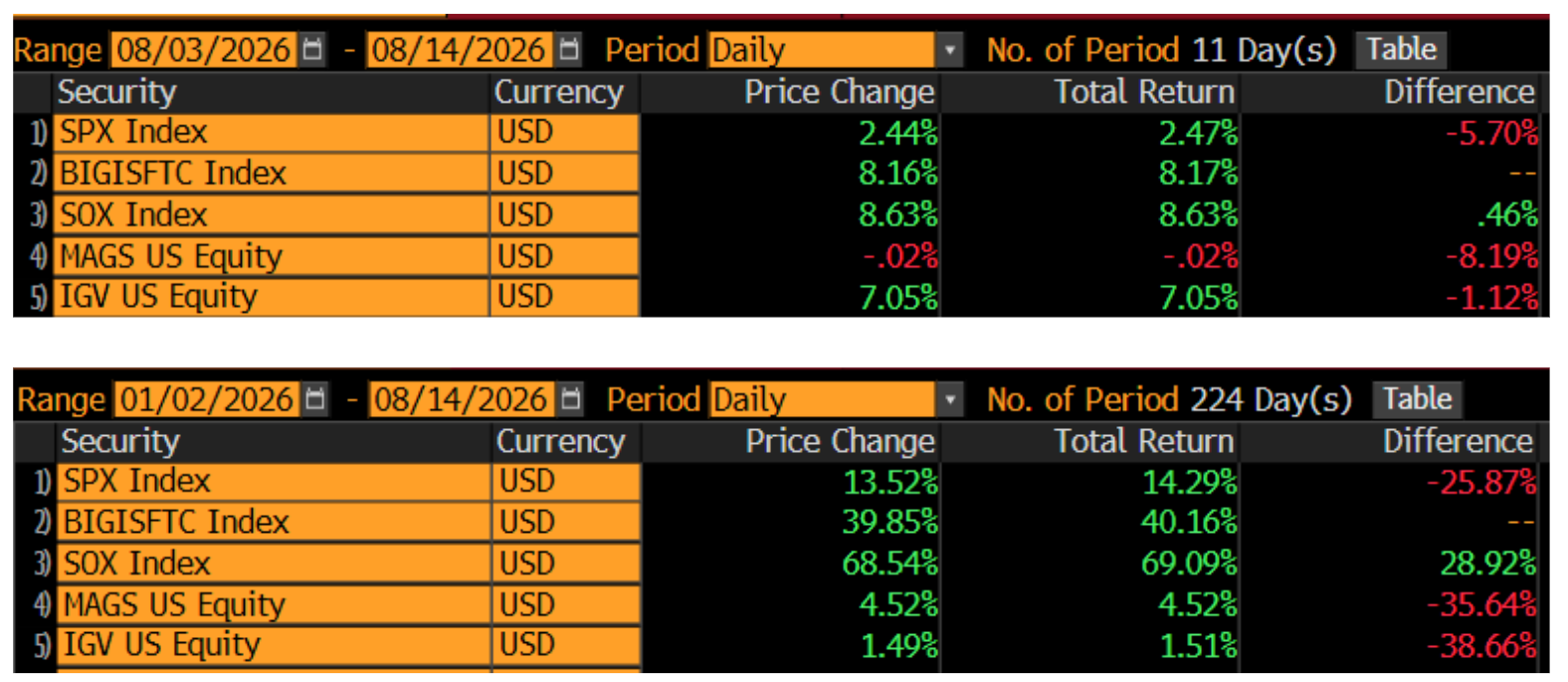
In August, Infrastructure Software (BIGISFTC) rose +8.16%, versus Software (IGV) at +7.0%, while the Semiconductor Index (SOX) remained strong at +8.6%, outperforming both the S&P 500 (SPX) at +2.4% and the Magnificent Seven (MAGS) at -0.2%. Year-to-date, the SOX remains the best-performing tech index at +68.5%, with Infrastructure Software close behind at +39.8%.
Figure 2 – Index Performance – YTD and August MTD
This month, 11 software companies have reported CYQ2 results, starting with ServiceNow two weeks ago, followed by Microsoft, Datadog, JFrog, Atlassian, DigitalOcean, and Cloudflare last week. Top-line growth, RPO growth (backlog) and most importantly, forward guidance all inflected upwards. These software results continue to suggest that the role of infrastructure software is expanding as it helps convert tokens into enterprise value and distribute intelligence across applications, users, devices, and workflows. This marks a major shift from the sweeping "SaaSpocalypse" narrative that weighed heavily on the sector earlier in the year. While early AI spending was concentrated on foundational models and training clusters, enterprises are now moving into production, deployment, and monitoring. That operational shift changes everything: code needs to be managed, multi-cloud infrastructure needs to be observed, software binaries and large model artifacts need secure tracking, and automated AI agents require reliable communication pipelines.
Figure 3 – The AI Data Stack
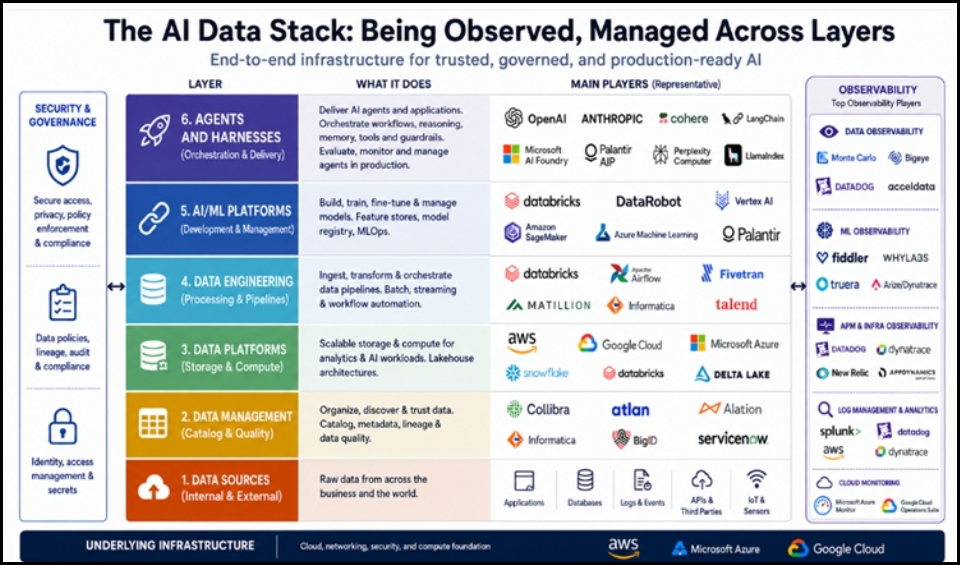
So, what is an AI data stack? Think of it as a collection of core IT infrastructure, data sources, data management, storage and compute platforms, and increasingly the agents and AI harnesses required to convert enterprise data into contextual intelligence. Each layer has a distinct role, but the ultimate value of the stack depends on these technologies functioning as a coordinated system capable of delivering intelligence that is efficient, reliable, secure and governed. For example, Datadog’s tools satisfy a critical need for observability, which is essential to monitoring AI agents as they begin to act autonomously across a diverse set of applications and workflows. Enterprises need to understand if their infrastructure is functioning optimally, what data an agent is using, and what actions were taken and why. Similarly, JFrog benefits directly from a surge in developer velocity: when engineering teams ship AI-generated code and manage complex containerized artifacts at scale - pipeline security ceases to be optional. Meanwhile, Twilio's messaging and communication APIs are proving indispensable as companies rush to wire autonomous AI agents into customer-facing workflows.
The broader message from last week’s reports was clear: proliferating tokens require more infrastructure, not less, creating expanding opportunities across the infrastructure software stack that directly benefit several of our holdings.
Differentiating Between Application and Infrastructure Software
The divergence within software is becoming impossible to ignore. General seat-based application software (such as Salesforce, Adobe, HubSpot, and Workday) continues to face structural headwinds, but infrastructure software providers are proving that they can monetize the AI transition directly. The simple reason is that agentic coding is far more complicated than a chatbot. An agent is more valuable with a robust context window, meaning the more data you can assign securely and effectively to the agent, the more productive it becomes. Infrastructure software provides the necessary scaffolding around the model to unlock that productivity.
The Next Shot
In golf, legendary champion Ben Hogan was once asked what shot he considered the most important during a tournament. His answer was famously concise: "The next one." You cannot change a missed fairway on the previous hole, and worrying about the back nine before you've cleared the current shot only introduces unneeded tension. The job is simply to execute on the ball in front of you.
We try to apply that same discipline to portfolio management. The trickle-down effects of AI spending have started to reach the infrastructure software level. This divergence matters because it refutes the early bear case that software would be disintermediated or squeezed out by foundational model providers. We believe the influx of open-source and open-weight models will help offset the skyrocketing costs of tokens, but it also increases architectural complexity for enterprises. In our view, infrastructure software companies are ideally positioned to benefit from that increase in complexity.
Over the course of our history managing portfolios, market leadership has always evolved, and our job is to ensure your capital moves with it. By sticking to that discipline, we hope to capture the next leg of structural growth as it unfolds.
Have a great week!
Tony, Sam & JLO