


Understanding Covered Call Strategies on Newly Public, High-Volatility Stocks.
The public-market debut of SpaceX has created exactly the kind of investor moment that Wall Street loves: a famous company, a visionary founder, a massive addressable market, a soaring first-day valuation, and no shortage of debate about what the business is actually worth.
It has also created something else: a live case study in how income strategies work when they are applied to a newly public, high-volatility stock.
That matters because many DIY investors are no longer looking at high-growth stocks only through the lens of capital appreciation. Increasingly, they are asking a second question: Can I turn this volatility into monthly income?
That is the basic appeal of covered call strategies. They own the underlying stock, or gain exposure to it, and sell call options against some or all of that exposure. The option premiums collected can help fund distributions. In plain English, the strategy attempts to convert part of a stock’s future upside potential into current cash flow.
On a volatile stock, that trade-off can look especially attractive. But it also deserves a closer look.
Why a Newly Public Stock Can Be an Income Machine
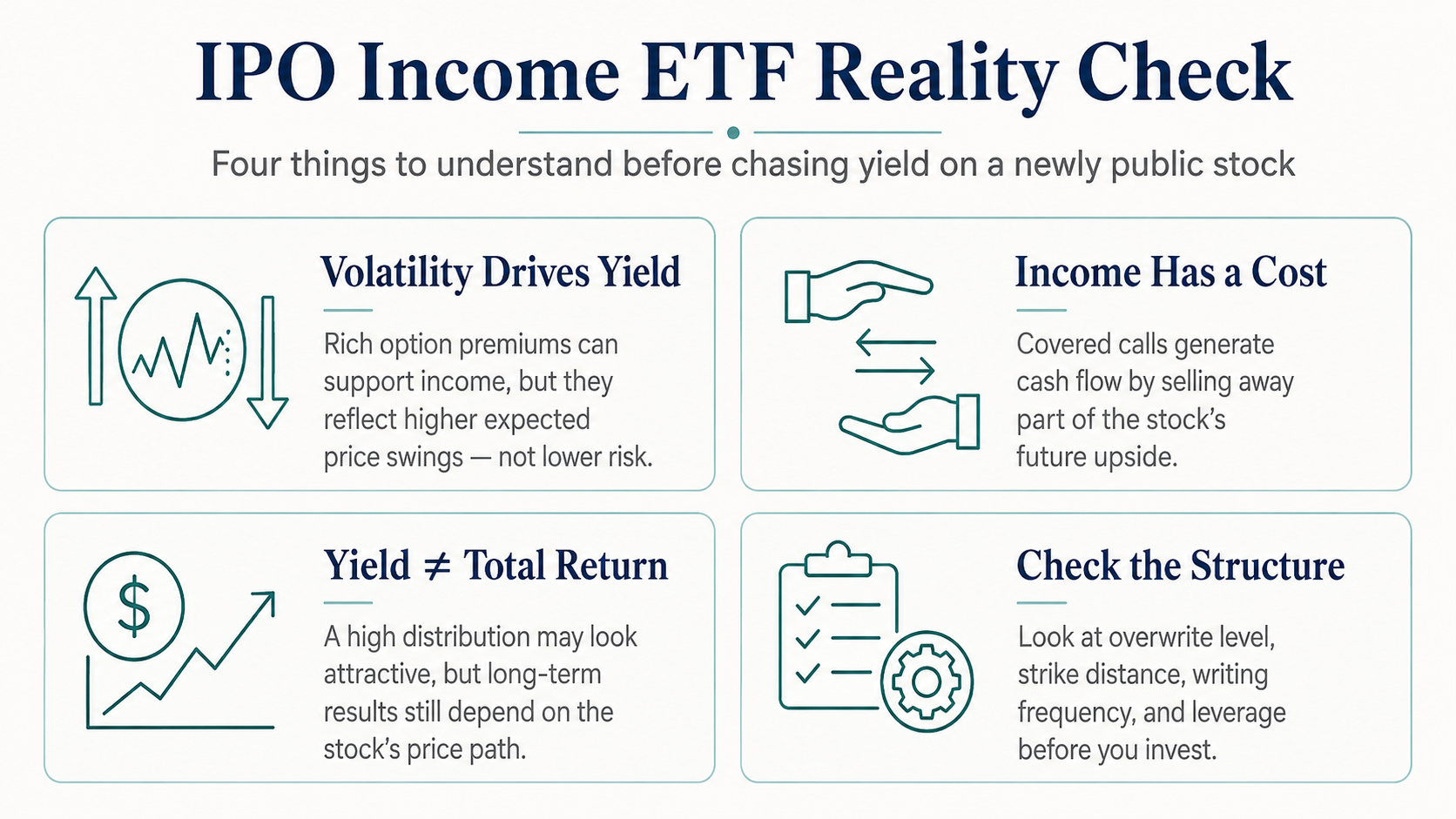
Options are not priced randomly. One of the key inputs into option pricing is expected volatility. The more a stock is expected to move, the more expensive its options tend to be.
That is why newly public, highly followed stocks can become fertile ground for covered call strategies. A company like SpaceX arrives in public markets with intense investor demand, limited trading history, uncertain valuation anchors, a potentially constrained public float, and enormous disagreement about future outcomes. Bulls may see a category-defining platform company. Skeptics may see a valuation that already discounts decades of success.
That disagreement is exactly what creates option value.
When investors are willing to pay for upside exposure, downside protection, or short-term speculation, option premiums can rise. A covered call manager can potentially collect those premiums by selling calls to other investors. The more volatile the stock, the richer the premium may be.
That is the income opportunity. But it is not free money.
The Core Covered Call Trade-Off
A covered call strategy usually works like this:
The portfolio owns the stock. It then sells a call option, giving another investor the right to buy the stock at a set price, known as the strike price, for a set period of time. In exchange, the portfolio receives an upfront premium.
That premium is income. But the call option creates a cap on some of the upside.
For example, suppose a stock trades at $100 and a covered call strategy sells a one-month call with a $110 strike. If the stock finishes the month below $110, the option may expire worthless and the strategy keeps the premium. If the stock rises to $130, the strategy may still participate up to roughly $110, plus the premium collected, but it gives up much of the additional upside above the strike.
This is the heart of the strategy. Covered calls can improve income, but they generally reduce participation in significant upside moves.
That is why they can be useful for investors who want income from an equity position, but less ideal for investors whose primary goal is to capture every dollar of potential upside.
On a stock like SpaceX, that distinction matters.
The SpaceX Lesson: Volatility Cuts Both Ways
The excitement around SpaceX is understandable. It sits at the intersection of space launch, satellite internet, defense, communications infrastructure, and investor fascination with transformative technology. But the same qualities that make the stock exciting also make it difficult to value.
Newly public companies often have limited public-market history. Early trading can be heavily influenced by supply-and-demand mechanics, index inclusion expectations, lockup expiries, retail enthusiasm, institutional positioning, and short-term options activity. In the first weeks and months after an IPO, the stock price may say as much about market structure as it does about long-term business value.
For covered call investors, that creates both opportunity and risk.
Higher expected volatility can increase option premiums, which may support higher distributions. But high volatility also means the underlying stock can move sharply in either direction. A covered call premium can soften a decline, but it does not eliminate stock risk. If the stock falls 30%, a 3% or 5% option premium may help, but it will not feel like a bond coupon.
This is one of the most common misunderstandings about covered call ETFs. The income may look bond-like on a factsheet, but the risk still comes primarily from the underlying equity.
Distribution Yield Is Not the Same as Total Return
DIY investors should be especially careful when comparing income strategies by headline yield alone.
A high distribution rate can be attractive. It can also be incomplete. What matters over time is total return: price change plus distributions received, net of fees and taxes.
Covered call strategies can produce meaningful cash flow, but the source of that cash flow is important. Option premiums are compensation for giving something up: usually a portion of future upside, and sometimes flexibility in how the portfolio behaves. In strong bull markets, a covered call strategy may lag the underlying stock because the best-performing names are repeatedly called away or capped. In flat or choppy markets, the income may add value. In falling markets, the premium may cushion losses but not prevent them.
That means the “best” covered call ETF is not automatically the one with the highest distribution. Investors should ask what kind of market environment the strategy is designed for.
A high-volatility stock can support high option income, but it can also produce high path dependency. The order of returns matters. A sharp rally after calls are written may limit upside. A sharp decline after premiums are collected may still leave investors with significant losses. A sideways market with repeated volatility may be the more favourable environment.
What to Look For in a Covered Call ETF
When evaluating covered call ETFs on a newly public stock, investors should look beyond the monthly distribution and ask several practical questions.
First, how much of the position is overwritten? A fund that writes calls on 25% of its exposure behaves very differently from one that writes calls on 100%. The more it overwrites, the more income it may generate, but the more upside it may surrender.
Second, how far out of the money are the calls? Calls written close to the current stock price usually generate more premium, but they cap upside sooner. Calls written further above the current price usually generate less premium, but allow more room for the stock to rise before gains are limited.
Third, how often are options written? Weekly option writing can be more tactical and potentially generate more frequent premium capture, but it may also increase turnover and sensitivity to short-term market moves. Monthly writing may be simpler and more aligned with standard option cycles.
Fourth, does the ETF use leverage? Leverage can magnify income and return potential, but it also magnifies losses and volatility. For many investors, this is the line between an income strategy and a speculative trading vehicle.
Fifth, what is the manager’s objective? Some covered call ETFs are designed to maximize current income. Others try to balance income with participation in long-term growth. Those are not the same mandate.
A Useful Way to Frame the Decision
For DIY investors, the question is not simply: “Do I like SpaceX?”
The better question is: “What role would this exposure play in my portfolio?”
If the goal is maximum long-term upside from a transformative company, a covered call strategy may not be the cleanest expression.
The income comes at the cost of some upside participation.
If the goal is to generate cash flow from a volatile equity theme while retaining some exposure to the underlying stock, a covered call ETF may be more relevant.
If the goal is capital preservation, a single-stock covered call strategy is probably the wrong starting point. The income may be attractive, but the underlying risk is still concentrated equity risk.
That is the key point. Covered call ETFs can change the return profile of a stock, but they do not change the nature of the asset into something risk-free. A SpaceX covered call ETF is still, at its core, tied to the fortunes and valuation of SpaceX.
The Bottom Line
The SpaceX IPO has turned into more than a stock-market event. It is a useful reminder that public markets are not just about owning companies. They are also about market structure, investor demand, volatility, option pricing, and product design.
Covered call strategies can make sense for investors who understand the bargain they are making: income today in exchange for giving up some potential upside tomorrow. On a high-volatility stock, that bargain can look especially compelling because option premiums may be rich. But the same volatility that creates the income opportunity can also create sharp losses, capped gains, and performance that differs meaningfully from the stock itself.
For DIY investors, the lesson is simple: do not chase the yield without understanding the engine behind it.
In income investing, as in rocket science, thrust is only useful if you understand the trajectory.