

Is Owning
the Index
Enough?
Global energy demand, geopolitical uncertainty and shifting economic conditions continue to create opportunity in the sector. But broad exposure alone may not capture the companies best positioned to benefit.
Key Takeaways· A favourable sector backdrop does not make every energy company equally attractive. Asset quality, balance sheet strength, capital allocation and valuation can drive very different outcomes. · Political and economic uncertainty can create mispricing. Energy security, shifting government priorities and the risk of higher rates can move sentiment faster than fundamentals. · Broad sector exposure may miss some of the most compelling opportunities. In energy, security selection can matter as much as sector exposure. |
Energy Is Too Important to Treat as One Trade
Energy is no longer just a commodity cycle story. It sits at the centre of economic growth, inflation, national security and a more fragmented global order. Yet energy investing is still often reduced to a simpler question: where are oil prices headed?
That may be too narrow a lens.
Demand continues to be supported by industrial activity, rising electricity needs, artificial intelligence, data centres and manufacturing. At the same time, natural production declines, capital discipline and long development timelines limit how quickly supply can respond.
The implications extend beyond the commodity itself. Energy prices can affect inflation, corporate margins and interest rate expectations. A stronger commodity backdrop may lift producer revenues while also tightening financial conditions for more leveraged businesses.
The result is a sector with a constructive long-term backdrop, but not a uniform opportunity set.
Energy Has Become a Question of Trust
Global energy markets increasingly reflect a world in which governments, alliances and trade relationships can no longer be taken for granted.
Geopolitical conflict, shifting policy priorities and a renewed focus on domestic supply have elevated the importance of energy security. For Canada, resource depth, existing infrastructure and proximity to the U.S. market offer meaningful strategic advantages.
That does not eliminate uncertainty, however. Regulatory delays, infrastructure constraints, taxation and changing political priorities can still affect project economics and investor confidence. Energy security is increasingly tied to infrastructure, domestic supply and dependable trading relationships.

These pressures can move entire sectors quickly. For investors, the challenge is distinguishing temporary shifts in sentiment from developments that genuinely change underlying business value.
A Rising Oil Price Can Hide a Weak Business
Higher commodity prices can lift the sector, but they do not make every producer equally attractive.
Asset quality, reserve life, production costs, leverage and capital requirements all influence how effectively commodity revenues turn into sustainable free cash flow. Capital allocation matters too. Companies that reduce debt, repurchase undervalued shares or reinvest selectively can produce very different shareholder outcomes from those pursuing growth at any cost.
Markets do not always reflect those differences cleanly. A company with high-quality assets and strong cash flow potential can still trade at a discount because of broader sector sentiment, temporary concerns or indiscriminate selling. That is where a closer look becomes useful.
|
In energy, the key distinction is not simply between good and bad businesses. It is between what a business is worth and what the market is asking investors to pay for it. |
The Opportunity an Index Can Miss
Passive energy strategies can be an efficient way to gain sector exposure. But a market-capitalization-weighted index is designed to reflect market value, not to identify where the best value may lie.
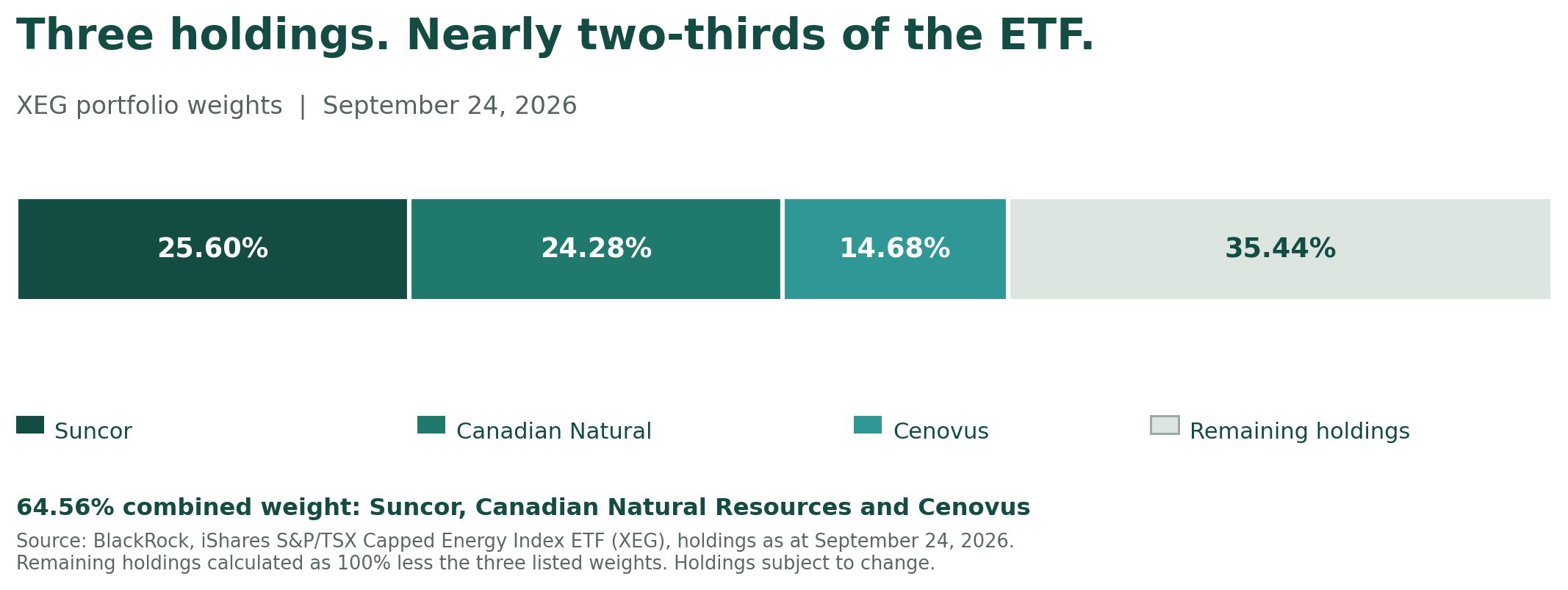
Consider the iShares S&P/TSX Capped Energy Index ETF (XEG), a widely used Canadian energy ETF. As at September 24, 2026, three companies made up nearly two-thirds of the fund. Concentration is not inherently a weakness, but it shows how index weightings follow market values rather than conviction about the relative attractiveness of individual businesses.
Broad indices may also underrepresent smaller companies whose assets are underappreciated or whose strategic value is not fully recognized. In some sectors, uncovering those companies takes deep, specialized research into reserve quality, cost structures and capital allocation.
That is where active management can play a role. In a sector as cyclical and company-specific as energy, a dedicated portfolio manager can focus capital where fundamentals and valuation look most compelling, and act when market dislocations create opportunities that broad exposure may dilute.
That comes with trade-offs. Concentrated positions can increase volatility, manager judgment can be wrong, and higher fees create a hurdle to outperformance. But in a sector where company-level outcomes can diverge meaningfully, broad exposure may not be enough.
What Advisors May Want to Consider
For advisors, the more useful question may not be whether energy belongs in portfolios, but how that exposure is being built. Three questions can help frame the discussion:
- What role should broad, index-based energy exposure play in the portfolio, and what role should selective exposure play?
- How much company-level concentration is acceptable for your clients, and how would you measure whether it’s justified?
- What would have to be true for an active energy strategy to justify its higher fees over a passive alternative?
Passive exposure may be enough to participate in the cycle. Capturing value beyond the cycle may require a more selective approach.
|
In energy, owning the sector is not always the same as owning the opportunity. |