
Commentary





Year-to-date to September 30, the Ninepoint Crypto and AI Leaders ETF generated a total return of +7.05%. For the quarter, the Fund generated a total return of +8.02%.
NINEPOINT CRYPTO AND AI LEADERS ETF - COMPOUNDED RETURNS¹ AS OF SEPTEMBER 30, 2026 (SERIES ETF USD- TKN.U) | INCEPTION DATE: JANUARY 27, 2021
|
|
1M |
YTD |
3M |
6M |
1YR |
3YR |
5YR |
INCEPTION |
|
FUND |
2.09% |
7.05% |
8.02% |
30.91% |
-8.00% |
38.35% |
8.91% |
13.14% |
The crypto and AI markets traded places in Q3 2026, with crypto staging a forceful comeback just as the AI trade caught its breath. On paper, the environment could hardly have been less hospitable, with the unraveling of the U.S.-Iran peace framework sending WTI crude back above $100, the Fed delivering its first rate hike since 2023, long-term Treasury yields rising to multi-decade highs, and, closer to home for crypto, the CLARITY Act failing its Senate cloture vote. Even so, crypto climbed this wall of worry decisively, as prices began converging with fundamentals. As we wrote last quarter, “just as AI valuations caught up to their fundamentals in Q2, we believe crypto will in time do the same,” and in Q3, that’s exactly what we began to see. Bitcoin delivered its best third quarter in nearly a decade, shrinking its year-to-date correction to single digits and spearheading a sharp rebound across other major crypto assets and select related equities. The AI trade, meanwhile, largely consolidated, with big tech and software names drawing an outsized bid as investors rotated toward the first half’s laggards.
Within this environment, the Fund generated a total return of +8.02% in Q3 2026, trailing the historic rally in large-cap crypto assets including Bitcoin (+42.78%), Ethereum (+69.49%), and Solana (+58.30%). For perspective, this compares to the Nasdaq Composite (+2.62%), the Magnificent Seven (+11.35%), and the iShares Expanded Tech-Software Sector ETF (+17.46S%).
Zoom out, however, and the Fund’s value proposition comes clearly into view. Even one of the strongest quarters in their history was not enough to lift Bitcoin (-4.65%), Ethereum (-10.30%), or Solana (-7.03%) out of negative territory year-to-date, while the Fund has delivered a total return of +7.05%. And the longer the lens, the starker the contrast. Over the past year, the Fund’s -8.00% compares to Bitcoin’s -27.17%, Ethereum’s -36.15%, and Solana’s -46.15%. To be sure, these three assets are today the Fund’s largest holdings (indirectly via listed crypto ETFs), and our conviction in each remains firm. But as we have discussed, crypto spent much of the past year battling through a bear market, and passive single-asset investors absorbed the full brunt of it. Our actively managed, diversified, dual-theme mandate allowed us to stay defensive through the depths of crypto winter and mitigate the full extent of that downside, while preserving the flexibility to go back on offense the moment the tide turned. And that’s precisely what we did (see portfolio activity below).
Now, with capital and attention returning to crypto, the question for investors is shifting from whether to own it to how. We believe the Ninepoint Crypto and AI Leaders ETF is the answer. Crypto is not a single-asset asset class, and today, many of its fastest-growing verticals sit well beyond Bitcoin, in stablecoins, tokenization, decentralized finance, perpetuals, prediction markets, and the public companies building and adopting the technology. The Fund owns that entire stack in a single ticket, pairs it with leading AI names, and places it in the hands of dedicated crypto specialists who actively manage it through every phase of the cycle.
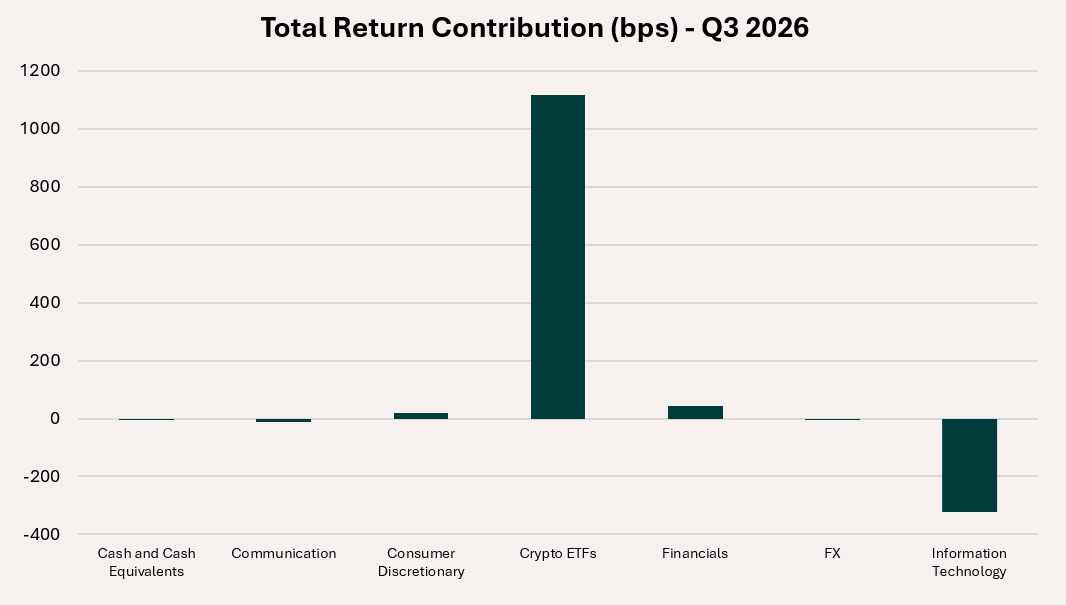
From a sector attribution perspective, Q3 2026 saw Crypto ETFs (+1,117 basis points) drive the bulk of the Fund’s gains, followed by Financials (+44 basis points) and Consumer Discretionary (+21 basis points). On an individual basis, the largest contributors were Bitcoin (+396 basis points), Ethereum (+351 basis points), and Solana (+251 basis points), all held indirectly via listed crypto ETFs and reflecting the powerful recovery in spot crypto asset prices. The lone material sector detractor was Information Technology (-322 basis points), while the largest individual detractors were TeraWulf Inc. (-197 basis points), Cipher Digital Inc. (-153 basis points), and Riot Platforms, Inc. (-100 basis points), as the high-performance compute infrastructure complex at the core of the AI buildout retreated meaningfully following its exceptional first-half run-up, amid a broader rotation away from the physical layer of the AI trade.
Click for larger image
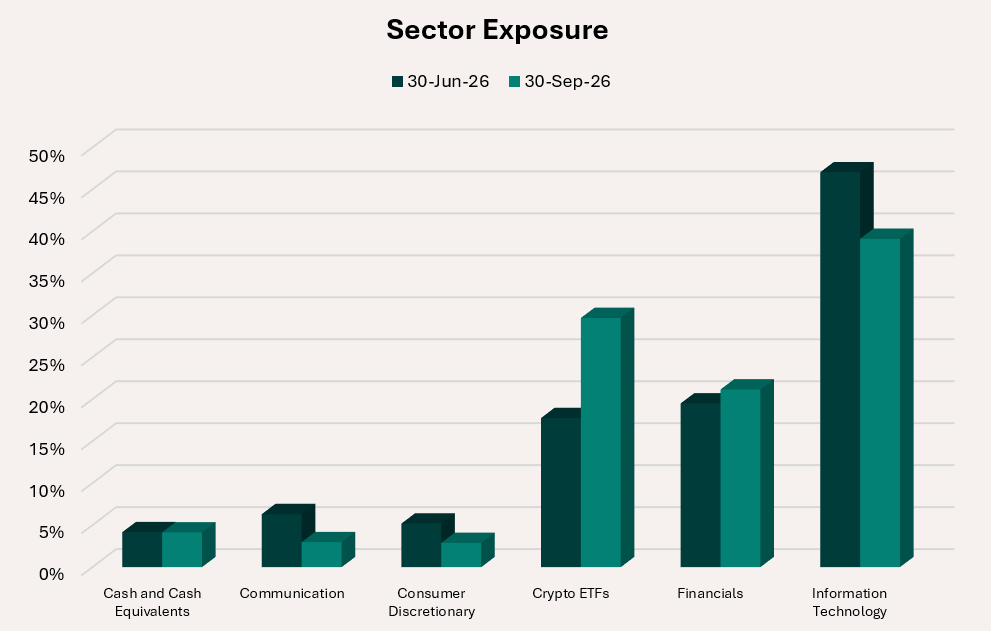
Throughout Q3 2026, we put our active mandate to work, repositioning the Fund to capture the turn in crypto markets. The most significant shift came in Crypto ETFs, where a combination of new purchases and strong price appreciation lifted our exposure from 17.77% to 29.69%, bringing the Fund right up against its maximum allowable allocation of 30% to crypto assets as our conviction in the recovery grew. To fund this, we pared back Information Technology from 47.05% to 39.12%, driven largely by a lower weighting in high-performance compute infrastructure, which fell from 15.54% to 8.79% of the Fund as we trimmed positions amid the complex’s pullback. We also reduced Communication (6.32% to 2.98%) and Consumer Discretionary (5.20% to 2.89%), and together, these moves lowered our exposure to AI leaders from 41.66% to 31.54%. Financials, meanwhile, rose modestly from 19.51% to 21.17%, part of a broader push into crypto-related equities, which climbed from 19.82% to 24.63% across the portfolio as we added to the public companies building at the forefront of the industry and best positioned to benefit from renewed activity and adoption. Our cash position held steady at roughly 4%, preserving dry powder to deploy as opportunities emerge. Taken together, the Fund entered the quarter leaning toward AI and exited it leaning firmly toward crypto.
Click for larger image
If the first half of the year tested the conviction of even the most seasoned crypto investors, Q3 rewarded it. Across our commentaries and mid-year outlook, we argued that crypto’s fundamentals and prices had decoupled in a way that simply did not add up. As we wrote in June:
“Historically, crypto prices have led adoption. In 2026, that relationship has inverted: adoption is scaling while prices lag. In our view, this rare dislocation between fundamentals and price may prove to be one of the defining investment opportunities of this cycle.”
Holding that view was no easy task while crypto languished and the AI trade marched relentlessly higher. Yet just weeks later, on July 1, Bitcoin hit its yearly low of $57,700, and the long-awaited catch-up began in earnest. So, what lit the fuse?
The spark came on August 19, when, with U.S. federal debt topping $40 trillion and long-term yields climbing, the U.S. Treasury announced it would double its buybacks of long-dated bonds. The amount was small, but the message was unmistakable: the government was stepping in in an attempt to hold down its own borrowing costs. Fearing debasement, investors rushed toward scarce assets, with Bitcoin rising 7.0% and gold 4.2% that day. By August’s end, Bitcoin's 90-day correlation with gold had climbed to its highest level since 2020, while its correlation with the Nasdaq-100 had fallen to a one-year low. But, while gold gave back its entire post-announcement gain within two weeks, Bitcoin kept climbing, powered by two forces. First, a short squeeze. Many traders were betting on further declines, and when prices jumped, $4.6 billion of those positions were forcibly closed over three days. The resulting buying pushed prices even higher. Second, ETF demand returned. After $3.6 billion of net outflows in H1 2026, spot crypto ETFs gathered $7.2 billion in Q3, flipping year-to-date flows positive. Even so, this year's $3.6 billion of inflows is a fraction of the $38 billion and $41 billion gathered in 2024 and 2025, respectively, a sign that capital is only beginning to return. Perhaps most telling of all was how the market handled mid-September, when the CLARITY Act’s failed cloture vote, WTI crude’s climb to roughly $106, and the Fed’s first rate hike since 2023 all landed within 48 hours. Crypto dipped as the headlines hit, but like a beach ball held underwater, it quickly resurfaced and finished the week higher. When a market rises through this much bad news, it is often a sign the worst is behind it.
After a quarter like this, the natural question is whether the opportunity has already passed, and whether those who sat on the sidelines simply missed the trade. We don’t believe they did. For one, the recovery has so far reclaimed only a portion of the ground lost. Even after Q3, Bitcoin (-4.65%), Ethereum (-10.30%), and Solana (-7.03%) all remain in negative territory year-to-date, and each still trades well below its all-time high, at -33.79%, -45.82%, and -59.98%, respectively. More importantly, we see three reasons why this rally may have considerably further to run.
First, as we have been vocal about all year, crypto’s fundamentals never entered a bear market. Prices did, but adoption never slowed down, and today, by nearly every measure, it stands at all-time highs and is accelerating. Stablecoins approached $300 billion in circulation. Tokenized assets, led by treasuries, commodities, and equities, grew roughly 70% year-over-year to $40 billion. Prediction market volume reached $370 billion year-to-date, nearly 5.7x the total for all of 2025. Solana processed more weekly trades (208 million) than the NYSE (190 million) for the first time in history. And trading itself is moving onchain at a remarkable pace: spot volume on decentralized exchanges (DEXs) reached a record 25.22% of that on centralized exchanges in September, up from 18.29% in 2025 and 7.25% in 2024, while open interest on decentralized perpetual futures exchanges climbed to an all-time high of $26 billion, up from $15 billion and $1.4 billion over the same periods. Chainalysis’s 2026 Global Crypto Adoption Index captured this divergence perfectly: while crypto’s market capitalization contracted by roughly $2.1 trillion, or about 50%, from peak to trough, onchain economic activity held virtually flat, slipping just 1.6% to $9.4 trillion, sustained by a “growing diversity of use cases, not price speculation.” Institutions tell the same story. While sentiment sat in extreme fear, the world’s largest financial institutions did anything but retreat; if anything, they used the downturn to accelerate. On Wall Street, Morgan Stanley launched Bitcoin, Ethereum, and Solana ETFs, and Citi, Deutsche Bank, and BNY all moved to offer crypto custody or staking to institutional clients. In market infrastructure, the DTCC processed its first live tokenized trades, the NYSE and Nasdaq began building 24/7 tokenized stock platforms, and Circle launched its Arc blockchain with BlackRock, DTCC, Mastercard, and Visa among its founding validators. In payments, Swift launched a blockchain ledger for 17 global banks to settle cross-border transactions in tokenized deposits around the clock, and 21 global banks, including Citi, Goldman Sachs, and Bank of America, teamed up to launch a joint stablecoin. Even Vanguard is hiring its first head of digital assets, and closer to home, Canada’s Big Six banks are exploring a tokenized deposit system. The institutions that once dismissed crypto are now building on it at scale.
Second, a new market cycle appears to be underway, with seasonality firmly on its side. Crypto has historically moved in four-year cycles: three years of strong gains followed by a sharp drawdown in the fourth. Bitcoin fell 30% in 2014, 74% in 2018, and 64% in 2022, each the fourth year of its respective cycle. By that pattern, 2026 should have been another year of steep losses. Instead, Bitcoin is down just 4.65% year-to-date, a remarkable departure from every prior fourth year on record. Why? In our view, because this cycle has been running ahead of schedule on both ends. Investors didn’t wait for the calendar to sell. They began at Bitcoin’s all-time high last October, turning a roughly 33% year-to-date gain in 2025 into a loss by year-end, the first negative third year in Bitcoin’s history. And they didn’t wait to buy, either. At its July 1 low, Bitcoin was down as much as 33% year-to-date, very much in line with a typical fourth-year drawdown, yet in the three months since, it has erased nearly all of that decline. In other words, the fourth-year correction arrived early, and so, it appears, did the bottom. Last quarter, we suggested Bitcoin could extend its decline before bottoming sometime in Q4. Instead, many investors waiting for that Q4 low now find themselves on the sidelines, just as Bitcoin enters its historically strongest stretch of the year. Since 2013, Q4 has delivered a median return of +47.7%, led by October, which has historically been Bitcoin’s best month with an average gain of nearly 20%, and November, which has been strong in its own right.
Third, regulatory headwinds are turning into tailwinds. The CLARITY Act’s cloture vote failure stings, but it is far from the endgame. Crypto grew into a multi-trillion-dollar asset class without it, stablecoins already have a federal framework under the GENIUS Act, and the vote lifted the pass-or-fail uncertainty that had hung over the market all year. We have long believed that if CLARITY stalled, the SEC and CFTC would step in quickly, and they have. Within days of the cloture vote, the SEC opened the door to onchain trading of tokenized U.S. stocks with an Innovation Exemption, and the CFTC sent new crypto market rules to the White House for review. Agency rules can change with administrations, but adoption cannot be legislated away. With supportive regulators in place until at least the 2028 election, crypto has a two-year window to prove it.
Beyond the fundamentals, the technical backdrop has also shifted meaningfully in crypto’s favour. Bitcoin closed Q3 at roughly $83,600, having broken cleanly upwards through its 50-day ($77,300), 100-day ($70,300), and 200-day ($71,300) simple moving averages, each of which had served as overhead resistance through much of the first half. It now sits comfortably above Realized Price, the aggregate cost basis of all coins in circulation, at roughly $53,300, the level we flagged last quarter as the market’s floor of last resort. Perhaps most significantly, Bitcoin reclaimed its 50-week moving average ($78,300), which has acted as a stubborn ceiling in past bear markets. Historically, a sustained break above this level has been one of the more reliable signals that a bear market has ended. Looking ahead, the key level to watch is $87,600, where Bitcoin began the year. It was turned back there twice in late September, making it the most important near-term resistance to clear, and a decisive move above it would push Bitcoin into positive territory for the year and, in our view, open the door to a broader continuation of the recovery.
That said, the path forward is unlikely to be a straight line, and there are several risks we continue to watch closely. The first, as we flagged last quarter, is Digital Asset Treasuries (DATs), where Q3 brought an encouraging development: DATs bought just $2.2 billion of crypto on a net basis, down 96% from $27.4 billion a year ago. That crypto rallied so strongly without their support suggests a broader, more organic base of buyers is now driving the recovery, and with the perpetual preferreds of leading DATs, such as Strategy’s STRC and Strive’s SATA, back near their $100 par value after falling into the $70 to $80 range this summer, the overarching market concern of forced selling has eased. It has not disappeared entirely, however. As we have noted previously, so long as some DATs continue to trade at discounts to the net asset value of their crypto holdings, the incentive remains for them to sell crypto to fund share buybacks or meet financing obligations, and it is a dynamic we will continue to monitor. Beyond DATs, we are also watching a still-hawkish macro backdrop, with the Fed signalling further hikes, yields at multi-decade highs, and the U.S. midterms approaching. Ultimately, having watched crypto rally through one of the more hostile macro environments in recent memory, we are encouraged by its resilience, and while Q4 will certainly bring its own tests, we believe the market is better positioned to meet them.
In closing, the setup heading into Q4 is one we have been waiting for all year. Crypto’s fundamentals are at all-time highs, institutional capital is returning, regulators are moving forward, and the asset class is entering what has historically been its strongest season, all with the Fund firmly positioned to benefit. Getting here required patience and discipline through one of the more challenging stretches in crypto’s history, and our dual-theme, diversified, and actively managed approach delivered both. Our conviction in the crypto and AI ecosystems remains unwavering, and we are confident the Fund is positioned to participate meaningfully in what lies ahead.
Until next quarter,
Ninepoint Digital Asset Group
A division of Ninepoint Partners LP