


Commentary
Print/PDF Print/PDF Subscribe

Ninepoint Fixed Income Strategy

Fixed Income Strategy - October 2026
Key Takeaways
  • We are starting to see some cracks in the AI capex cycle, as elevated funding costs are challenging business models. Availability of capital can no longer be taken for granted.
  • Weaker AI capex taking down equity prices is the main risk to the U.S. economy, as growth is increasingly dependent on this theme.
  • Despite core inflation solidly at 2%, the Bank of Canada has decided to join the hiking party.
  • The Fed paused in October, but broad and elevated inflation will require more hikes, unless the AI party falters first.

The monthly commentary discusses recent developments across the Ninepoint Diversified Bond, Ninepoint Alternative Credit Opportunities and Ninepoint Credit Income Opportunities Funds.

Never a Dull Moment

After a massive bond sell off in September, October saw a significant (but not complete) reversal of the prior month. Impressive how quickly the narrative changes! 

At the risk of oversimplifying, since the summer, a combination of elevated fiscal deficits, surging energy prices and strong economic growth due to the AI capex boom has led to higher interest rates. The U.S. exceptionalism story. 

Back in July, we argued that the solid growth the U.S. is experiencing is increasingly fragile, mostly driven by AI capex and elevated stock prices, whose wealth effect for the top tier of U.S. consumers is driving consumption. Very narrow growth. 

Since September, we have seen elevated interest rates, combined with wider credit spreads across the AI universe putting funding costs front and center. Many business models are incompatible with current High Yield market funding costs, which have jumped meaningfully since the summer. Even larger Investment Grade companies like Oracle, Broadcom, AMD, etc. have not been spared, and now see their credit spreads at much wider levels than the rest of the market (Figure 1 below shows a basket of AI related companies Credit Default Swaps Spreads versus the broader market). There’s only so much AI debt the bond market is willing or able to absorb, but these companies have a seemingly insatiable appetite for funding and keep on pushing the envelope. Public markets capture only part of the picture, with many AI companies utilizing off-balance sheet arrangements, banks, vendor (and circular) financing and private credit providers. 

You have to give it to them, the bankers on Wall Street are extremely apt at finding inventive and ingenious solutions to financing problems. But now it feels like we are reaching the limit. In 2025, it became clear that the AI capex boom couldn’t be funded with cash flow. In 2026 we got to the limit of debt markets, now is the time for equity markets to support this growth. Interestingly, META announced an equity raise following their third quarter earnings. We expect more companies to follow suit, if their stock prices allow it.

It is really hard to say exactly when the music stops, we’ve had these mini-cycles of discomfort around the AI story several times this year. This October episode could be just one more of those, with equity investors buying the dip, stocks rebounding, and bond investors turning their attention once again to elevated fiscal deficits and inflation. 

One thing is clear: companies across the datacenter and semiconductor supply chain have been racing to increase capacity. If datacenter CAPEX does slow, demand and prices will drop, earnings will follow, and many of the factors currently driving higher inflation will resolve themselves. At that point, we will be talking about rate cuts, not hikes. 

It is the tension between those two narratives that drove U.S. interest rates lower in October, as lower real rates (i.e. lower growth expectations) did most of the heavy lifting. While many have questioned Warsh on his call to hold interest rates at the latest FOMC meeting, it is prescient for the FOMC to move slowly.  Yes, inflation is too high, but given how fragile the economic story is, best to take their time, lest they make a policy mistake and have to backtrack.

Canada

Closer to home, the Bank of Canada (BoC) has decided to restart hiking, taking the overnight rate to 2.5% at their October meeting. We also received a new set of forecasts from them; they expect inflation to broaden from energy to many other categories and spend most of 2027 around 3%, and growth to be solid at around 2%. That’s a fairly high bar; for context, Bay Street consensus for growth and inflation in 2027 is 1.7% and 2.3%, respectively. 

The BoC was careful in its messaging, making sure to leave options open, and not pre-commit to a particular path or guiding toward another hike in December. Given how growth has disappointed to the downside in Q3 and the breadth of inflation has so far remained well contained (most if not all of the reason CPI inflation is 3% is due to energy prices, which they have no control on), our view is that the BoC is overly optimistic on growth, and overly pessimistic on inflation. Therefore, they will likely undershoot current market expectations, which are for a series of hikes all the way to 3.25% by this time next year. Plus, if the AI trade in the U.S. falters and risk assets sell-off, central banks around the world will likely respond with cuts.

Funds

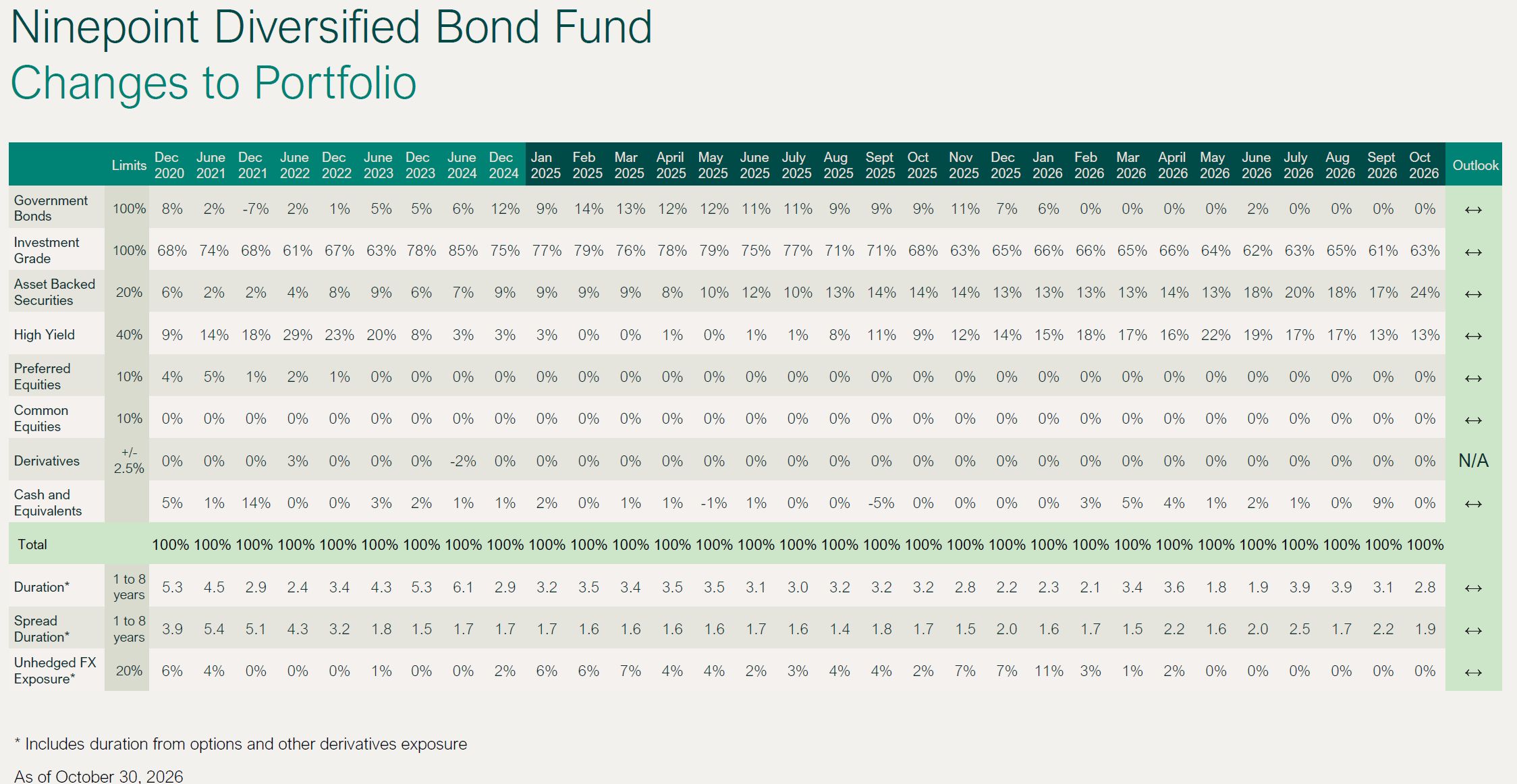
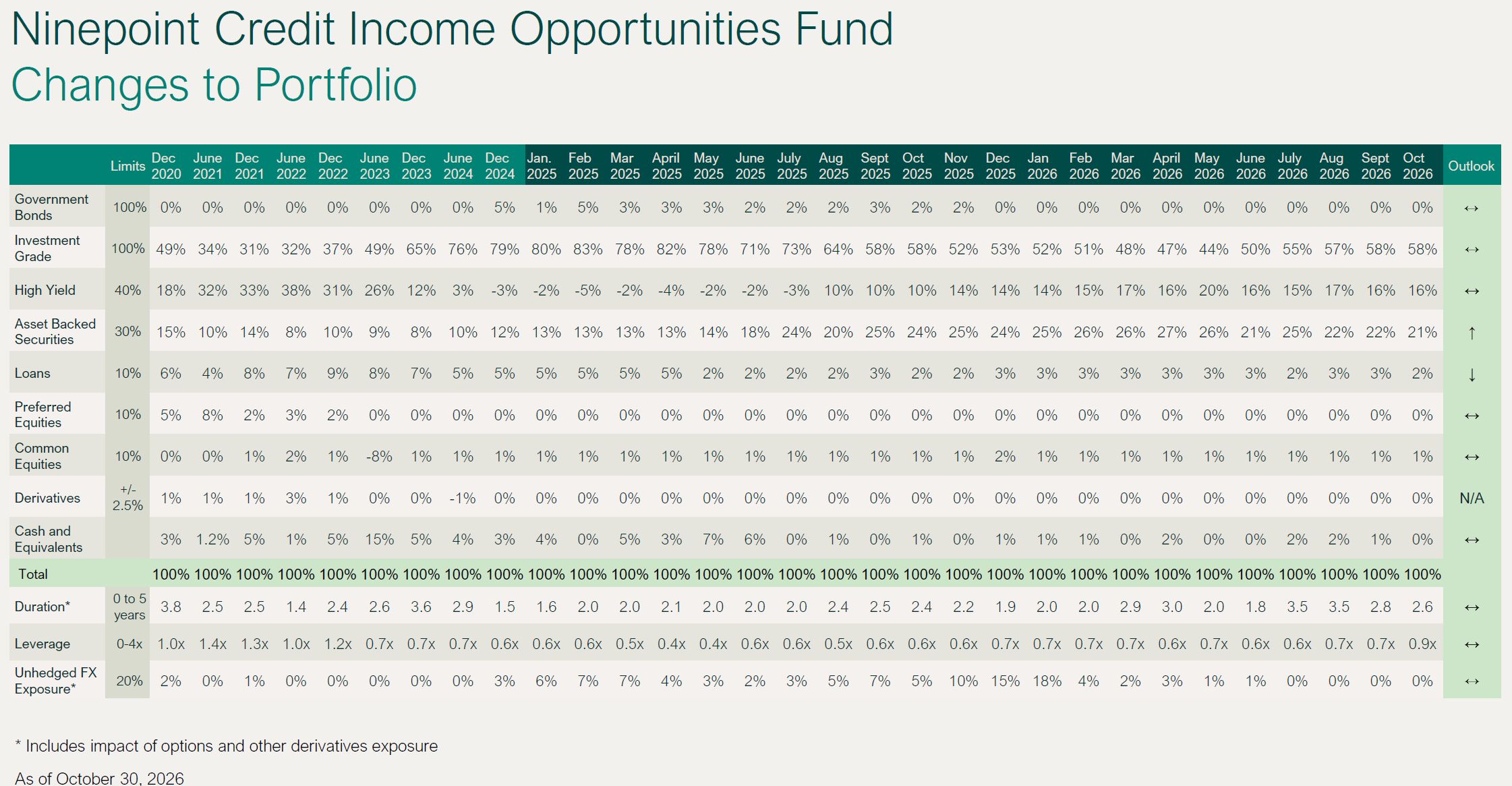
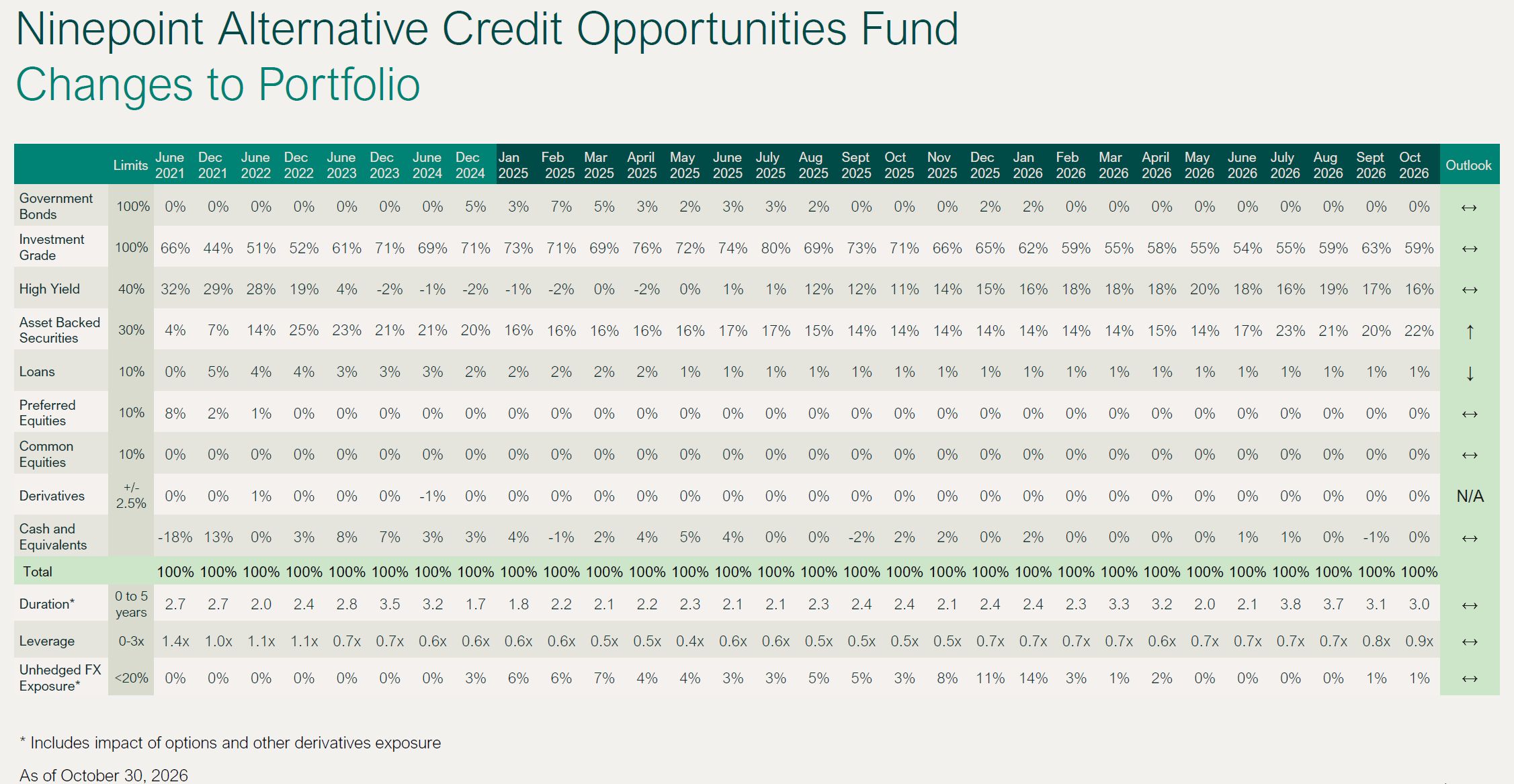
Table 1 below shows the various statistics and exposures as of October month end. We kept duration almost unchanged (down slightly by 0.2-0.3 years). Unless things change materially, expect duration to remain between 2.5 and 3.5 years for the foreseeable future. Credit duration is down slightly from last month, as we rolled our CDX option hedges into November and December contracts. 

We increased leverage modestly in our alternative strategies, which we offset with more CDX hedges. We found interesting opportunities in ~10 month investment grade corporate bonds that offer good risk/reward.

Portfolio yields remain very healthy, ranging from 5.6-6.7%. As we have said for years, in testing times, yield is your first line of defense.

Table 1: Fund Characteristics as of October 31 2026.


Duration (years)

Credit Duration (years)

Yield-to-Maturity

Current (cash) Yield

Leverage

Diversified Bond (F)
Mutual Fund

2.8

1.9

5.6%

5.4%

N/A

Alternative Credit Opportunities (F)
Liquid Alternative

3.0

2.1

6.6%

7.1%

0.9x

Credit Income Opportunities (F)
OM

2.6

1.9

6.7%

6.9%

0.9x

Conclusion

It is excruciatingly hard to know how and at what pace this AI boom will play out, and now so many things hinge on that one narrative. Given our focus on capital preservation and income generation, we have a few tenets in times like this:

  • Focus on short-dated bonds (5-years and under), where pull to par is strong and interest rate risk is manageable.
  • Avoid trouble (in this case AI related) sectors.
  • Focus on companies and structures we know and trust.
  • Keep credit hedges on.

Until next month,

Mark, Etienne & Nick

As always, please feel free to reach out to your product specialist if you have any questions.

Ninepoint Diversified Bond Fund

NINEPOINT DIVERSIFIED BOND FUND - COMPOUNDED RETURNS¹ AS OF OCTOBER 31, 2026 (SERIES F NPP118) | INCEPTION DATE: AUGUST 5, 2010

1M

YTD

3M

6M

1YR

3YR

5YR

10YR

15YR

Inception

Fund

0.55%

1.13%

0.07%

0.16%

1.26%

6.61%

1.83%

2.54%

3.44%

3.46%

Click for larger image
Source: Ninepoint Partners. Subject to change without notice.
Ninepoint Alternative Credit Opportunities Fund

NINEPOINT ALTERNATIVE CREDIT OPPORTUNITIES FUND - COMPOUNDED RETURNS¹ AS OF OCTOBER 31, 2026 (SERIES F NPP931) | INCEPTION DATE: APRIL 30, 2021

1M

YTD

3M

6M

1YR

 3YR

5YR

Inception

Fund

0.47%

1.78%

0.10%

0.85%

1.92%

7.11%

2.70%

2.76%

Source: Ninepoint Partners. Subject to change without notice.

Click for larger image

Ninepoint Credit Income Opportunities Fund

NINEPOINT CREDIT INCOME OPPORTUNITIES FUND - COMPOUNDED RETURNS¹ AS OF OCTOBER 31, 2026 (SERIES F NPP507) | INCEPTION DATE: JULY 1, 2015

1M

YTD

3M

6M

1YR

3YR

5YR

10YR

Inception

Fund

0.27%

1.04%

-0.26%

0.19%

1.36%

6.70%

3.12%

4.71%

4.68%

Click for larger image
Source: Ninepoint Partners. Subject to change without notice.

Historical Commentary

View All
  • Ninepoint Fixed Income Strategy
    September saw a massive sell-off in rates globally, and particularly in the U.S., where 10 and 30-year rates hit multi-decade highs (the sell-off continues, and they went as high as 5.36% and 5.73% at the time of writing).
    Fixed Income
  • Ninepoint Fixed Income Strategy
    The conflict in Iran seems ever more stuck, with both sides increasingly irreconcilable. The buffers and reserves the world relies on to limit the damage of product shortages and higher prices are getting smaller, pressuring finished product prices (gasoline and diesel in particular) higher.
    Fixed Income
  • Ninepoint Fixed Income Strategy
    The fragile ceasefire between the U.S. and Iran broke in July, driving oil prices higher. The situation remains fluid, but it seems like the U.S. doesn’t want to escalate any further, given the political and economic sensitivity to gasoline prices (now over $4 a gallon nationwide). Moves in U.S. interest rates are also top of mind, with 30-year yields at their highest since 2007 (Figure 1 below).
    Fixed Income
  • Ninepoint Fixed Income Strategy
    What a year it has been so far. We are now past the mid-point of 2026, and as we typically do, we will recap the year so far, and offer our thoughts for the second half.
    Fixed Income
  • Ninepoint Fixed Income Strategy
    For those that are counting, it has now been (at the time of writing) the 38th time that we “have a deal” with Iran. Granted, this time it does feel like we are getting close to an interim agreement for a ceasefire and to reopen the Strait of Hormuz, with a 60-day timeline to resolve the thornier issues, with Iran’s nuclear program the main sticking point.
    Fixed Income
  • Ninepoint Fixed Income Strategy
    Another year, another set of unexpected challenges. This time it’s not Liberation Day and a global trade war, but instead a real war in the Middle East.
    Fixed Income
  • Ninepoint Fixed Income Strategy
    In February, the release of certain AI tools led to doubts about the business model of many software companies. Could AI simply replace their products quickly and much more cheaply? Their stocks fell, and with that their bonds, as well.
    Fixed Income

Ninepoint Diversified Bond Fund returns and fund details are a) based on Series F units; b) net of fees; c) annualized if period is greater than one year; d) as at 10/31/2026. Ninepoint Credit Income Opportunities Fund returns and fund details are a) based on Class F units; b) net of fees; c) annualized if period is greater than one year; d) as at 10/31/2026. Ninepoint Alternative Credit Opportunities Fund returns and fund details are a) based on Class F units; b) net of fees; c) annualized if period is greater than one year; d) as at 10/31/2026.

The Risks associated with investing in a Fund depend on the securities and assets in which the Funds invests, based upon the Fund's particular objectives. There is no assurance that any Fund will achieve its investment objective, and its net asset value, yield and investment return will fluctuate from time to time with market conditions. There is no guarantee that the full amount of your original investment in a Fund will be returned to you. The Funds are not insured by the Canada Deposit Insurance Corporation or any other government deposit insurer. Please read a Fund's prospectus or offering memorandum before investing.

Ninepoint Credit Income Opportunities Fund is offered on a private placement basis pursuant to an offering memorandum and are only available to investors who meet certain eligibility or minimum purchase amount requirements under applicable securities legislation. The offering memorandum contains important information about the Funds, including their investment objective and strategies, purchase options, applicable management fees, performance fees, other charges and expenses, and should be read carefully before investing in the Funds. Performance data represents past performance of the Fund and is not indicative of future performance. Data based on performance history of less than five years may not give prospective investors enough information to base investment decisions on. Please contact your own personal advisor on your particular circumstance. This communication does not constitute an offer to sell or solicitation to purchase securities of the Fund. 

Ninepoint Partners LP is the investment manager to the Ninepoint Funds (collectively, the “Funds”). Commissions, trailing commissions, management fees, performance fees (if any), other charges and expenses all may be associated with mutual fund investments. Please read the prospectus carefully before investing. The indicated rate of return for series F units of the Fund for the period ended 10/31/2026 is based on the historical annual compounded total return including changes in unit value and reinvestment of all distributions and does not take into account sales, redemption, distribution or optional charges or income taxes payable by any unitholder that would have reduced returns. Mutual funds are not guaranteed, their values change frequently and past performance may not be repeated. The information contained herein does not constitute an offer or solicitation by anyone in the United States or in any other jurisdiction in which such an offer or solicitation is not authorized or to any person to whom it is unlawful to make such an offer or solicitation. Prospective investors who are not resident in Canada should contact their financial advisor to determine whether securities of the Fund may be lawfully sold in their jurisdiction.

The opinions, estimates and projections (“information”) contained within this report are solely those of Ninepoint Partners LP and are subject to change without notice. Ninepoint Partners makes every effort to ensure that the information has been derived from sources believed to be reliable and accurate. However, Ninepoint Partners assumes no responsibility for any losses or damages, whether direct or indirect, which arise out of the use of this information. Ninepoint Partners is not under any obligation to update or keep current the information contained herein. The information should not be regarded by recipients as a substitute for the exercise of their own judgment. Please contact your own personal advisor on your particular circumstances.

Views expressed regarding a particular company, security, industry or market sector should not be considered an indication of trading intent of any investment funds managed by Ninepoint Partners LP. Any reference to a particular company is for illustrative purposes only and should not to be considered as investment advice or a recommendation to buy or sell nor should it be considered as an indication of how the portfolio of any investment fund managed by Ninepoint Partners LP is or will be invested.

Ninepoint Partners LP and/or its affiliates may collectively beneficially own/control 1% or more of any class of the equity securities of the issuers mentioned in this report. Ninepoint Partners LP and/or its affiliates may hold short position in any class of the equity securities of the issuers mentioned in this report. During the preceding 12 months, Ninepoint Partners LP and/or its affiliates may have received remuneration other than normal course investment advisory or trade execution services from the issuers mentioned in this report.