Digital Asset Digest Newsletter
Print/PDF Print/PDF

Trump Memecoin Mania and Why Solana is the Big Winner

Trump Memecoin Mania and Why Solana is the Big Winner
PRICE SNAPSHOT
(7 Day Change as of January 24, 2025 8:35AM ET)
Bitcoin Price: $105,190  2.47%
DeFi Total-Value-Locked: $127.4B 2.91%
Ethereum Price: $3,399 (0.58%)
Crypto Market Cap: $3.63T 2.83%
Bitcoin Range: $99,717 - $108,900
TKN.U Close: $18.84 (as at Jan 15, 2025)
Ethereum Range: $3,136 - $3,521
TKN.U NAV: $18.83
Bitcoin Dominance: 57.30% 2.32%
TKN.U Premium: 0.05%
STORY OF THE WEEK
Trump Memecoin Mania and Why Solana is the Big Winner
By: Alex Tapscott, Managing Director of Digital Asset Group, a division of Ninepoint Partners, and Portfolio Manager of the Ninepoint Crypto and AI Leaders ETF at Ninepoint Partners

If you needed any more proof that we’re living in the strangest possible timeline, this past weekend Donald Trump, on the eve of his inauguration, announced his very own memecoin $TRUMP.

The token, launched on the Solana blockchain network, home to many memecoins (and plenty of other more useful assets and applications) instantly took over the internet.

Within a day, $TRUMP skyrocketed to $72 per token, and a fully diluted market value of $72 billion, worth more than the market value of Moderna, American Airlines, and Dropbox. It has since settled back down to $34.

In a fitting end to the weekend meme-mania, Melania Trump launched her own token, $MELANIA, which itself soared briefly into the billions of dollars. Rumours are Eric, Ivanka and other first family members are in the queue.

Now it lands on me to make some sense of this for our readers.

Let me start by saying I think memecoins are kind of dumb. Strangely, this is not the consensus view in the crypto world. Some people think memecoins help “build community” around shared ideas and culture. That might be true. But it’s also true that most memecoins, in the long run, lose most of their value. Some memecoins, like DOGE and PEPE have reached escape velocity and are now worth billions. They are the exception to the rule.

So basically. Memecoins are gambling. Gambling is not “good,” but it’s also mostly legal and broadly accepted in society these days. So, are memecoins just a bit of fun, then – like betting on The Super Bowl?

Not quite.

Consider $TRUMP the coin. Were people just speculating and having a bit of fun when they bought it? Or did they have other motivations? Maybe some of his followers saw this as an opportunity to somehow ‘invest in/with Trump’ Maybe they thought these tokens gave them ownership of one of Trump’s companies or buildings? Or maybe they thought this was a new kind of U.S. money that Trump was issuing as the incoming President. People can be exceptionally foolish and gullible with money. Or they can be very clever- perhaps some saw this as a way to compensate the incoming President and curry favour for later on. I worry a lot of people could get hurt and feel betrayed if this ends badly.

The TRUMP meme-coin raises other concerns. Is Trump using his position as incoming President to enrich himself? Will TRUMP coins become a convenient way for supports (including foreign nationals) to circumvent campaign finance rules and maybe influence the president directly? What kind of precedent does this set for other leaders around the world? One can imagine a dictator in a foreign country creating their own coin and demanding at gun-point that every citizen use it.

$TRUMP was also a missed opportunity for the incoming administration to show how government can be a model user of this technology. There are many examples of how to do this - through onchain voting and direct democracy via DAOs for example. Or by codifying new laws and regulations as smart contracts that only release funds as milestones are met.

Fortunately, in the past week, the administration has announced several initiatives that speak to a broader interest in the technology - including the creation of a strategic digital asset stockpile.

WHY SOLANA IS THE BIG WINNER OF $TRUMP

There are several positives to be gleaned from the launch of $TRUMP.

$TRUMP was a stress test for whether blockchain networks like Solana can handle a full-scale mobilization of investors and traders. The Solana network experienced its highest daily REV (real economic value) in history two days in a row, generating $131 million in transaction fees and tips in the first three days of the Trump launch which all went to stakers . Despite the crazy activity on the network, Solana maintained 100% uptime, which is a big win for them considering downtime has been one of their main criticisms over the years.

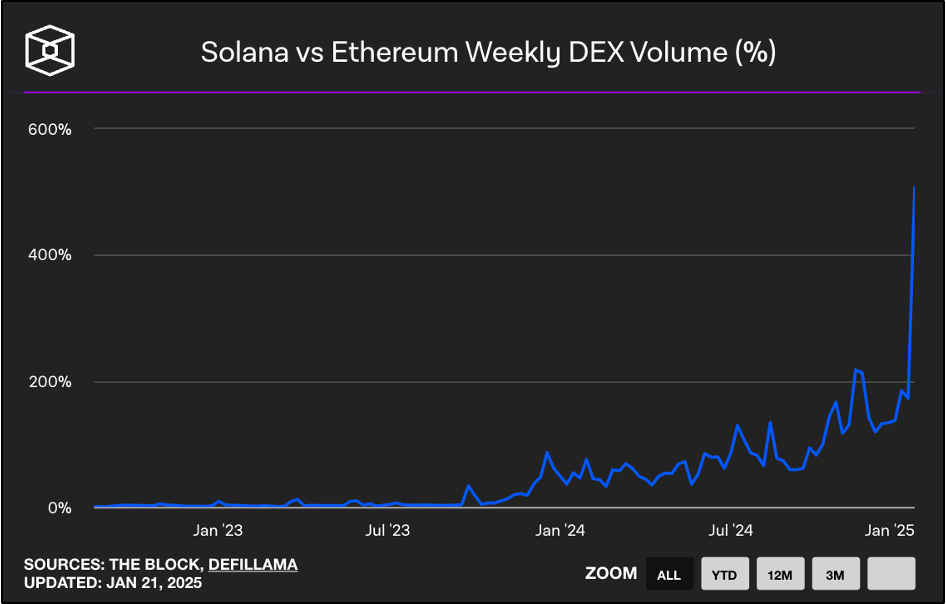
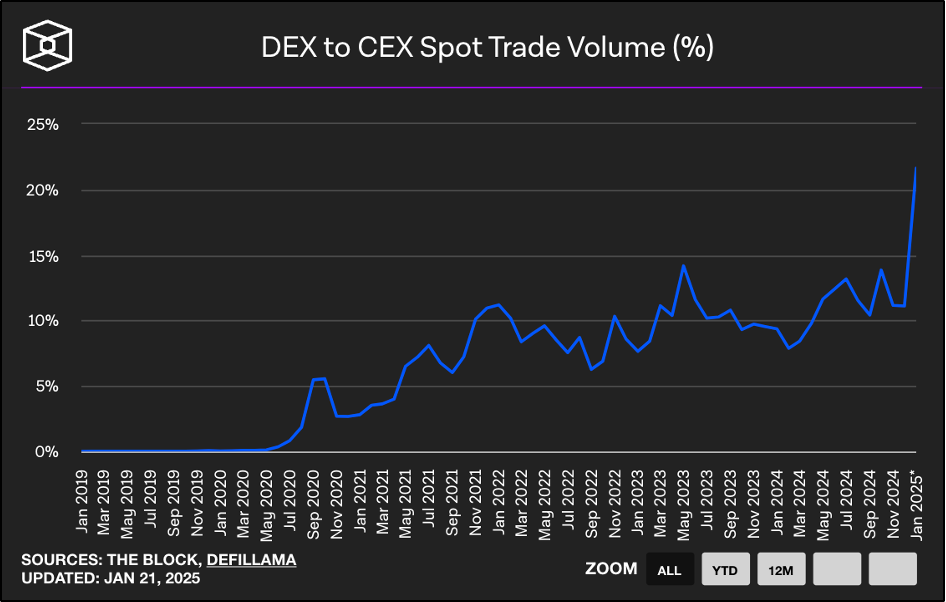
TRUMP’s launch nearly doubled decentralized exchange volume compared with centralized exchange volume ratio, as it was initially only available on Solana DEXs, before being listed on several CEX exchange and it sent the SOL-to-ETH DEX volume ratio from 175% to 510%.

AlexDAGChartJan221.png

Source: The Block

Decentralized exchanges generally don’t concentrate risk the way centralized exchanges do (such as FTX). The more decentralized crypto gets, the more resilient it becomes. Trump may have inadvertently been a part of that!

AlexDAGChartJan222.png

Source: The Block

A final word on memecoins. Benjamin Graham once said “In the short run, the market is a voting machine, but in the long run it is a weighing machine.” Let’s update that for our times: “n the short run, the market is an ‘aping’ machine but in the long run, it is a HODLing machine." Or, as crypto founder and thought leader Erik Voorhees said on X “Quantity wise, 99% of projects are bad and have zero utility. But value wise, 80-90% of all the value in the crypto market is in quality things (BTC, ETH, stables, DeFi, RWAs, etc.).”

Crypto makes it east to launch any token from anywhere. That’s kind of chaotic and weird but kind of beautiful. And it directly benefits the core platforms like Solana which stand to benefit the most from this explosion of new assets.

DEFI & DIGITAL ASSETS
Join Alex Tapscott and Andrew Young as they decode the world of Web3 and DeFi with special guest Dr. Friederike Ernst, Co-Founder of Gnosis. Listen in as they discuss how Friederike first got into crypto ten years ago and her journey in the space since then, what Gnosis is building and why the team views it as middleware, Gnosis’ transformation over the years and the vision behind Gnosis Chain, the current crossroads Ethereum faces and what Friederike believes needs to change, the process of spinning out both Cowswap and Safe, how they’ve developed, and more.
WHAT'S NEW IN WEB3
SEC Establishes Crypto Task Force to Create Clear and Sensible Rules for the Industry, Providing Clarity Sidelined Institutions Have Long Been Waiting For

The SEC has officially launched a crypto task force to establish clear rules for the crypto industry. Led by Commissioner Hester Peirce, known as “Crypto Mom” for her advocacy, the task force will guide efforts to craft legislation that supports innovation, protects consumers, and provides businesses with clear guidelines. The SEC acknowledged that its prior regulation-by-enforcement approach created confusion, stifled innovation, and enabled fraud. While corporate crypto adoption reached new highs in 2024, many institutions have remained sidelined, awaiting regulatory clarity before fully engaging in the space. This week, Bank of America CEO Brian Moynihan stated that the banking industry would aggressively move into crypto payments if regulators allowed it, while BlackRock CEO Larry Fink called for the SEC to “rapidly approve the tokenization of bonds and stocks.” This task force is one major step closer to unlocking such clarity.

Circle Acquires Onchain Issuer Hashnote to Integrate Largest Tokenized Money Market Fund with USDC for Seamless Yield-Bearing Collateral

Circle, the issuer of the $50 billion USDC stablecoin, has acquired Hashnote, a regulated on-chain asset manager, along with its flagship product, the Hashnote Short Duration Yield Coin (USYC). Founded in 2022, Hashnote offers customizable digital asset exposure, and USYC is the world’s largest tokenized treasury and money market fund, managing over $1.5 billion in assets. Circle plans to integrate USYC with USDC, providing smoother access between tokenized money market fund collateral and USDC. This collaboration is supported by DRW’s Cumberland, which will expand institutional liquidity and settlement capabilities. Additionally, Circle will deploy native USDC on Canton, enhancing secure and private financial applications with continuous convertibility between collateral and cash for traditional finance markets. In our 2025 predictions, we stated that a crypto IPO frenzy could occur in U.S. markets as regulatory clarity emerges; Circle is one of the largest crypto companies we believe will participate. As mentioned last week, crypto M&A activity has accelerated recently; for example, Chainalysis acquired Alterya for $150 million, and MoonPay acquired Helio for $175 million.

Phantom Wallet Raises $150 Million in Series C Round at $3 Billion Valuation to Become Leading Consumer Finance Platform

Phantom Wallet, the world’s most popular crypto wallet, has raised $150 million in a Series C round led by Sequoia Capital and Paradigm, pushing its valuation to $3 billion—a 150% increase from its $1.2 billion valuation in early 2022. Boasting 15 million monthly active users and $25 billion in self-custody assets, Phantom claimed that several metrics, including active traders, trading revenue, and trading volume in November and December, were many multiples higher on its platform than compared to Coinbase and MetaMask combined. Since its 2021 launch on Solana, Phantom has adopted a multi-chain approach, expanding its wallet functionality to support other networks like Bitcoin, Ethereum, Base, and Polygon. The new funding will help Phantom accelerate crypto adoption and position itself as a leading consumer finance platform.
QUANTITATIVE ANALYSIS
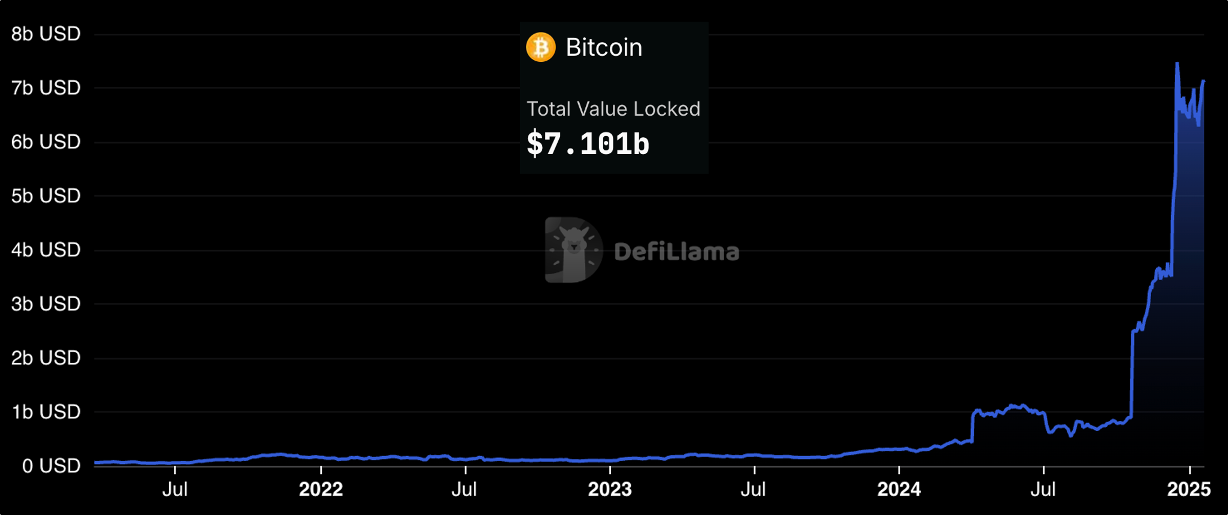
Chart 1:  Bitcoin is Evolving from a SoV into an Application Platform, and its TVL Boom is Proof
Bitcoin’s total value locked (TVL) has skyrocketed from $300 million to over $7 billion in just a year. This surge is due to Bitcoin’s evolution from a store of value to a platform supporting diverse activities, applications, and use cases. Innovations like Bitcoin layer two networks, the Rune economy with BRC-20 tokens, and Ordinals have made building within the Bitcoin ecosystem easier, fueling this growth. However, Bitcoin still ranks fourth in TVL, behind Ethereum ($66 billion), Solana ($12 billion), and Tron ($7.2 billion). Yet, with Bitcoin’s market cap-to-TVL ratio at 288x compared to Ethereum’s 6x, Solana’s 10x, and Tron’s 3x, we believe Bitcoin’s transformation into an application platform will be a key theme in 2025, and that the network's current TVL will be just a drop in the bucket of what's to come.

Chart: DeFiLlama
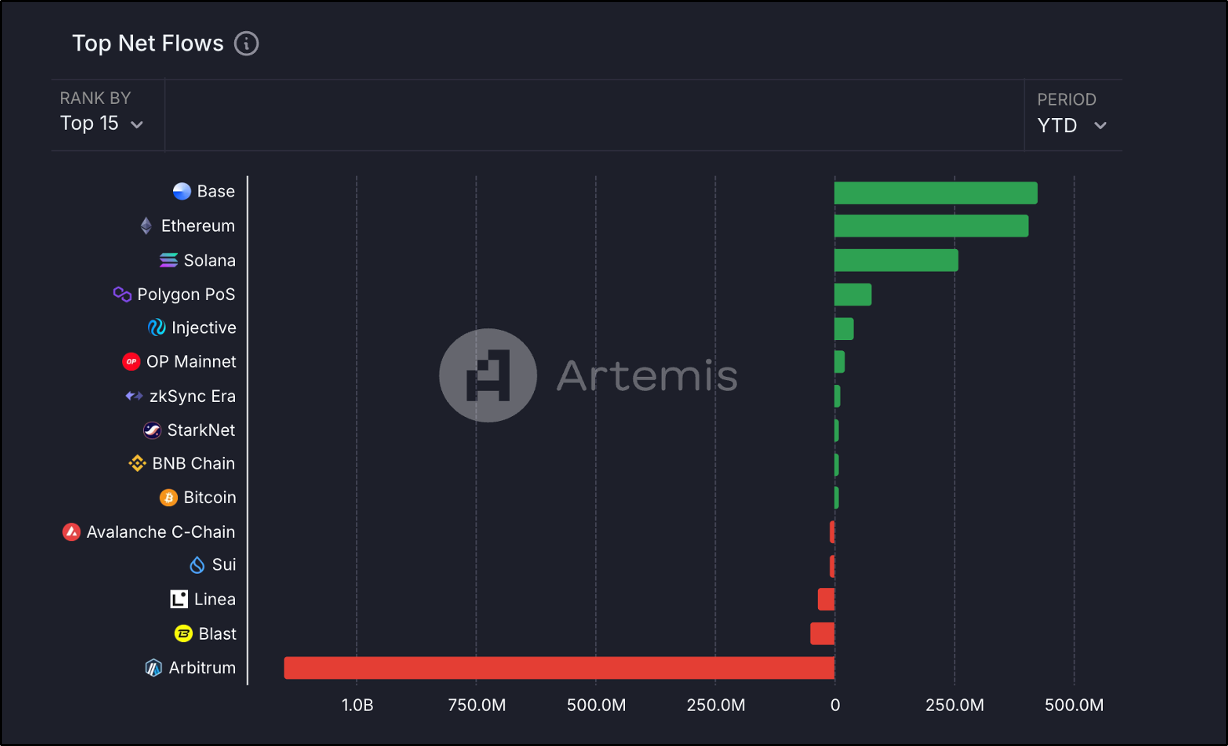
Chart #2:  2025 Onchain Flows Update: Top Ecosystems by Net Inflows and Outflows
We’re only three weeks into 2025, but we wanted to provide an update on where money is flowing onchain so far. Unsurprisingly, the top ecosystems by year-to-date (YTD) net inflows are Base ($430M), Ethereum ($406M), and Solana ($262M). Meanwhile, Arbitrum ($1.1B), Blast ($47M), and another ecosystem ($32M) have experienced the largest outflows. Base, Ethereum, and Solana are expected to continue attracting inflows, but newer networks like Sui, Monad, and Berachain are gaining attention and could capture a significant share of the pie. Last year, two key factors influenced ecosystem flows: Ethereum’s Dencun upgrade shifted users from L1 to L2s, and Solana saw a surge due to apps like PumpFun, which encouraged retail traders to quickly and cheaply launch and trade memecoins. We’ll continue to track onchain flow trends and report on any interesting developments that emerge.

Chart: Artemis
COMMENTARY & INSIGHTS