Digital Asset Digest Newsletter
Print/PDF Print/PDF

Do Some DATs Have an Implied Takeover Premium? Plus, The Revenge of Seasonality!

Do Some DATs Have an Implied Takeover Premium? Plus, The Revenge of Seasonality!
PRICE SNAPSHOT
(7 Day Change as of September 26, 2025 9:00AM ET)
Bitcoin Price: $109,467 (5.80%)
DeFi Total-Value-Locked: $147B (8.70%)
Ethereum Price: $3,942 (12.77%)
Crypto Market Cap: $3.75T (7.64%)
Bitcoin Range: $108,859 - $116,322
TKN.U Close: $20.92 (as at Sep 25, 2025)
Ethereum Range: $3,829 - $4,540
TKN.U NAV: $20.93
Bitcoin Dominance: 58.20% 1.93%
TKN.U Discount: 0.05%
STORY OF THE WEEK
Do Some DATs Have an Implied Takeover Premium? Plus, The Revenge of Seasonality!
By: Alex TapscottManaging Director of the Ninepoint Digital Asset Group, a division of Ninepoint Partners, and Portfolio Manager of the  Ninepoint Crypto and AI Leaders ETF  at Ninepoint Partners

2025 may be the year of the Snake in the Chinese calendar, but for crypto investors, it will be remembered as the year of The DAT. Since the beginning of the year, DATs (digital asset treasury companies) have raised more than $20 billion, more than other IPOs combined.

To recap: DATs, starting with MicroStrategy (now Strategy) pioneered a powerful model: so long as the company was trading at a premium to NAV, it was able to issue new shares to buy Bitcoin, thus growing the Bitcoin per share (BPS). New DATs could capitalize on the success of older vintages by offering investors pricing closer to NAV. Expecting the public markets would re-rate the stock higher, crypto-native investors and other early adopters piled into this trade. Mostly they were correct.

We’ve talked about this Flywheel Effect in various editions of Digital Asset Digest ( first, in May when we examined why DATs could keep outperforming SPOT, and again more recently, analyzing the reflexivity of the DAT flywheel).

DATs are not new to readers of this newsletter.

What is new is that the DAT trade has become a bit more challenging as more of these vehicles see their market values get closer to NAV.

In fact, right now about 50 percent of DATs trade below NAV and that is up from only 25 percent of DATs below NAV at the start of September.

We still believe high quality teams can keep the flywheel going, defending the premium and growing accretively. But not everyone can succeed with this ‘infinite money glitch.” Which means the next trend in the DAT space will be DAT M+A! Matt Levine, a Bloomberg Columnist, wrote a good piece on this topic Monday, and we’ve covered it in past editions of the newsletter and podcast. TL;DR – Big DATs will swallow little DATs. So long as the acquirer has a richer premium than that of the target, it’s accretive. This means DATs can grow without raising fresh investor capital, which is a bit exhausted now. In the end we may have a few champions for each asset.

My theory is that some (but not all) DATs will begin to reflect this take-out premium potential, if they haven’t already.

Initially most M+A will occur between two DATs holding the same asset, for example one big Bitcoin company acquiring another smaller Bitcoin holder. The more players there are, the more likely combinations and acquisitions.

As a result, all else being equal, small Bitcoin DATs should have an implied takeout premium built into their share price because if they did too far below NAV, then someone will just scoop them up in an Apples for smaller Apples rollup. Or, alternatively, an activist investor will take a position and force a sale or special dividend or some other corporate action to unlock value.

The deepest pools of single asset DATs are in Bitcoin (8 DATs), Ethereum (8 DATs) and Solana (7 DATs). For example, in Bitcoin, Strategy (1.3x mNAV) could roll up Nakamoto (0.71x mNAV). And in Solana, Forward Industries (1.8x mNAV) could takeout DeFi Development Corp (0.9x mNAV).

For DATs that own other tokens, it’s more of a mixed bag. Many are trading at big premiums while others are struggling a little. It’s possible that these names will benefit from a scarcity premium but not a takeover premium as there is no natural acquirer.

It’s also possible this is a momentary dip as the market resets and awaits new investors who are evaluating how to get exposure to this asset class. Through ups and downs, we’re on the beat.

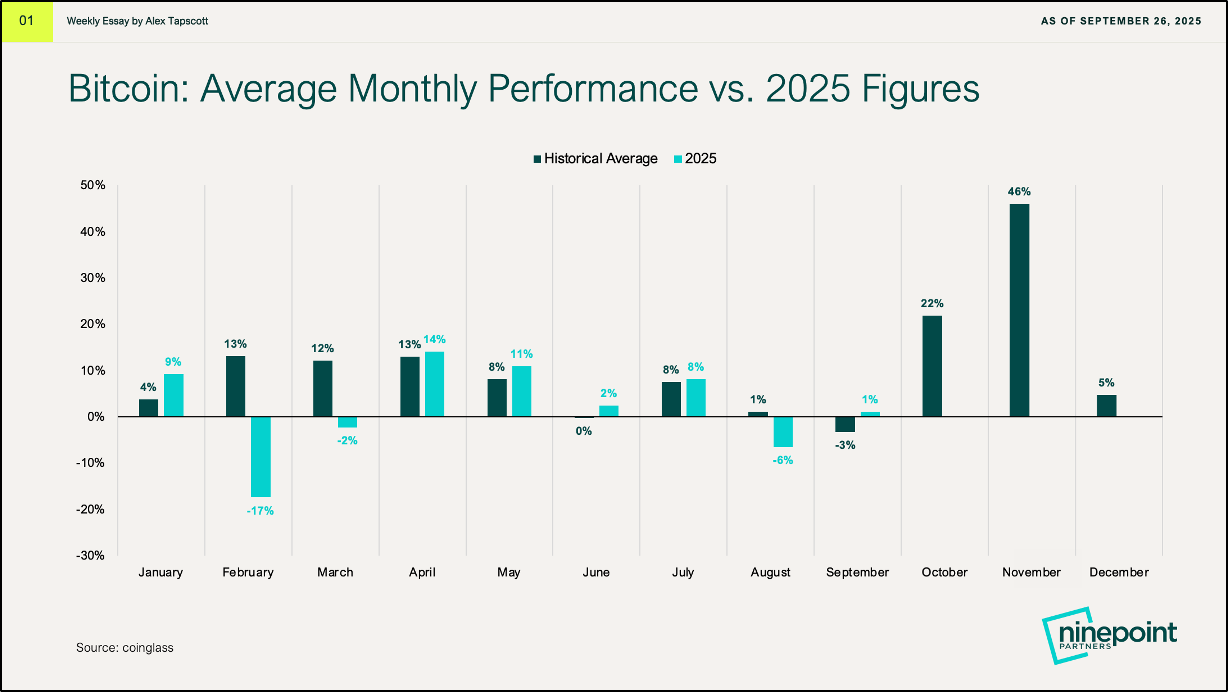
Finally, a thought on seasonality. As we wrote at the start of September, we discussed and dismissed the notion of seasonality in financial markets. Though I said, “with crypto I am more sympathetic to the seasonality theory, given the highly reflexive nature of the market” but concluded this time is different.

newchartalexessaysept261.png

Welp. I was wrong. This time is not, in fact, different. September is basically flat following a weak August. This is DEAD ON with past years. The good news is October and November are seasonally the strongest months by far. So if we’re leaning into finance astrology, then buckle up for what could be a big fall. Fall is reaping season. As Neil Young once sang, "will we go dancing in the light...of this Harvest moon?" We'll be cozying up with a Pumpkin Spice Latte to monitor the situation.

THIS WEEK ON DEFI DECODED
Join Alex Tapscott and Andrew Young as they decode the world of crypto. Listen in as they discuss the fading premiums and potential consolidation wave in DATs following the Strive-Semler merger this past week, the liquidity and centralization risks emerging in altcoin DATs, the evolving debate over stablecoin regulation from the GENIUS Act to the CLARITY Act as bank lobbying intensifies, how banks might fit into a stablecoin-driven financial system, the surge of crypto IPOs with Circle, Gemini and BitGo, the custody economics underpinning institutional adoption, the potential forthcoming Base token and what it could mean for Coinbase’s valuation, and more.
WHAT'S NEW IN CRYPTO
By: Jake Moodie , Analyst, Digital Asset Group at Ninepoint Partners

CRYPTO STORMS WALL STREET: IPOS, ETFS, AND TETHER’S $500 BILLION VALUATION

In 2025, one of the biggest trends has been crypto breaking into traditional public markets in a big way. If there’s one month that captures this shift, it’s this month, and especially this past week. Let’s break it down. First, the wave of crypto IPOs. Investor demand has been massive. This month alone we saw Gemini, the Winklevoss-led exchange, go public in a deal that was 20x oversubscribed, raising $425 million. Then came Figure, Mike Cagney’s blockchain-based lender, which pulled in $787.5 million in an upsized IPO. Both stocks jumped more than 25% on their first day, before cooling off. They follow other hot debuts this year like Circle and Bullish. And now, crypto custodian BitGo is next in line, having just filed with the SEC to go public, reporting $4.19 billion in revenue through H1 2025. Second, the SEC just approved generic listing standards for certain commodity-based ETFs (including those holding cryptoassets). That means exchanges can now list new qualifying crypto ETFs without waiting for a slow, case-by-case SEC review. It’s a huge step that should accelerate launches. With around 100 spot altcoin ETF filings already in the pipeline, we could see the next wave of approvals hit in the coming weeks and months. We’ve been saying more crypto ETFs would be a big year-end theme, and now it looks like they’re finally around the corner. Third, while not a public-market move, the news from Tether is just as big. The world’s largest stablecoin issuer, with its $180 billion USDT, is reportedly looking to raise $15–20 billion for about a 3% stake, valuing the company at roughly $500 billion. CEO Paolo Ardoino said the goal is to bring in a handful of high-profile investors to help scale Tether’s strategy even further. What a recent stretch it’s been.

U.S. REGULATORY CLIMATE APPEARS RIPE FOR TOKENS: POLYMARKET, COINBASE, AND METAMASK MAY BE TAKING NOTICE

In case the above commentary wasn’t enough, SEC Chairman Paul Atkins just unveiled that the agency is looking to roll out an “innovation exemption” for crypto firms by the end of the year. The idea is to let these companies launch products right away under lighter regulatory requirements, instead of having to follow the full securities rulebook on day one. If implemented, this would speed up new offerings and could be a major tailwind for U.S. crypto innovation. The timing here is wild. Just last week we talked about the massive re-rating in prediction market valuations. Polymarket, specifically, raised at a $1 billion valuation in June, and now, less than three months later, it’s reportedly gearing up to raise again, this time at a $10 billion valuation. Sure, some of that is thanks to getting the greenlight to relaunch in the U.S., but more importantly, it feels like the market is betting that the environment is finally right for tokens, particularly a Polymarket token. That idea has been floating around for years, but now it seems highly possible. If Polymarket does launch a token, one could only imagine the scale of the market’s appetite for it. And it doesn’t stop there. Just days later, news hit that Coinbase is exploring a token for its Ethereum layer-2 network Base, while Metamask announced it’s preparing to launch its own token imminently. Put all of this together, the SEC’s push for an innovation exemption, Polymarket’s explosive valuation jump, and these fresh token rumors, and it’s hard not to feel like something big is brewing. For a deeper dive, check out this week’s DeFi Decoded podcast where we break down what a Base token could mean for Coinbase and how the market may value it. Definitely something to keep an eye on.
QUANTITATIVE ANALYSIS
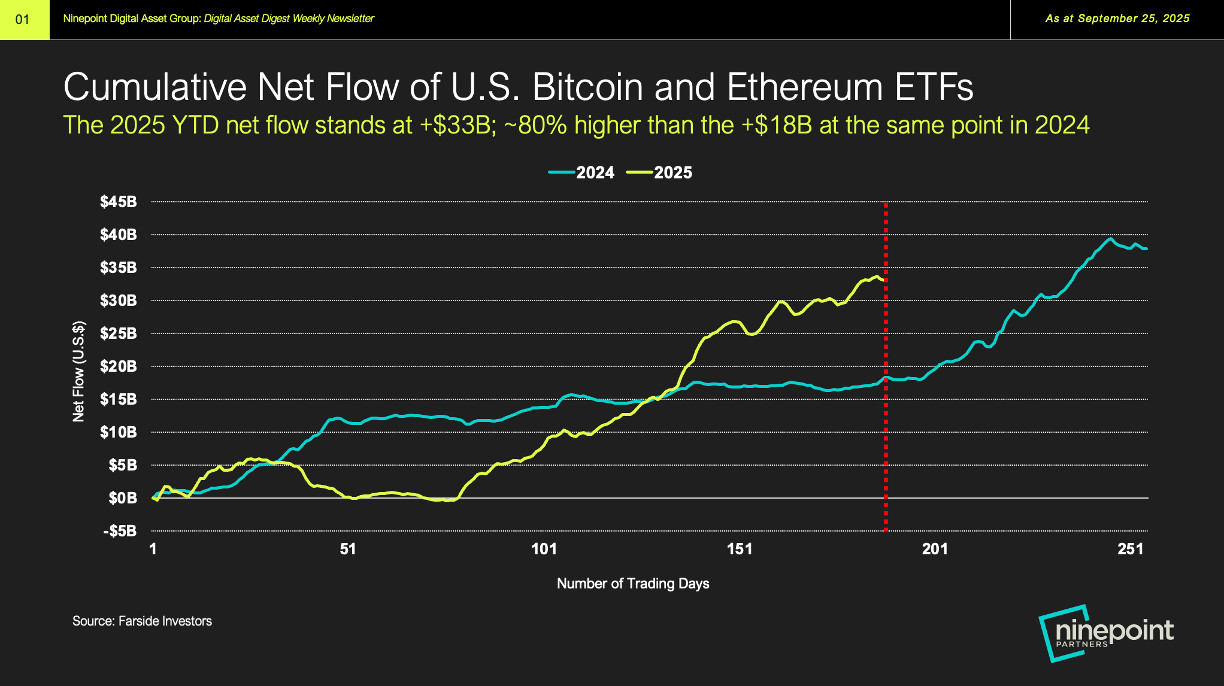
Chart 1:  BITCOIN AND ETHEREUM ETF FLOWS ARE RAPIDLY OUTPACING LAST YEAR'S
Bitcoin and Ethereum ETFs in the U.S. have already seen $33 billion of net inflows this year, about 80% more than the $18 billion they had gathered by this point in 2024. Last year ended with $38 billion in total inflows, capped by a strong finish as markets rallied around Trump’s election win. If this year’s lead carries through, 2025 could see close to $60 billion in inflows. That projection may be a touch optimistic, but $50 billion feels very realistic, especially given crypto’s reflexive nature, where rising prices attract new inflows that push prices even higher, and the fact that October and November are historically two of crypto’s strongest months. Globally, assets under management in crypto investment products have almost 3x in the past year, climbing from $86 billion in September 2024 to $240 billion today. This surge of institutional capital through ETFs, and also DATs, is steadily reshaping the market and creating the strongest foundation it has ever had. The clearest proof is Bitcoin itself, which continues to grind to new highs as its volatility declines to multi-year lows, suggesting that the wild, retail-driven boom-and-bust cycles of past bull markets may finally be giving way to a more stable and mature market structure. A positive trend to say the least.
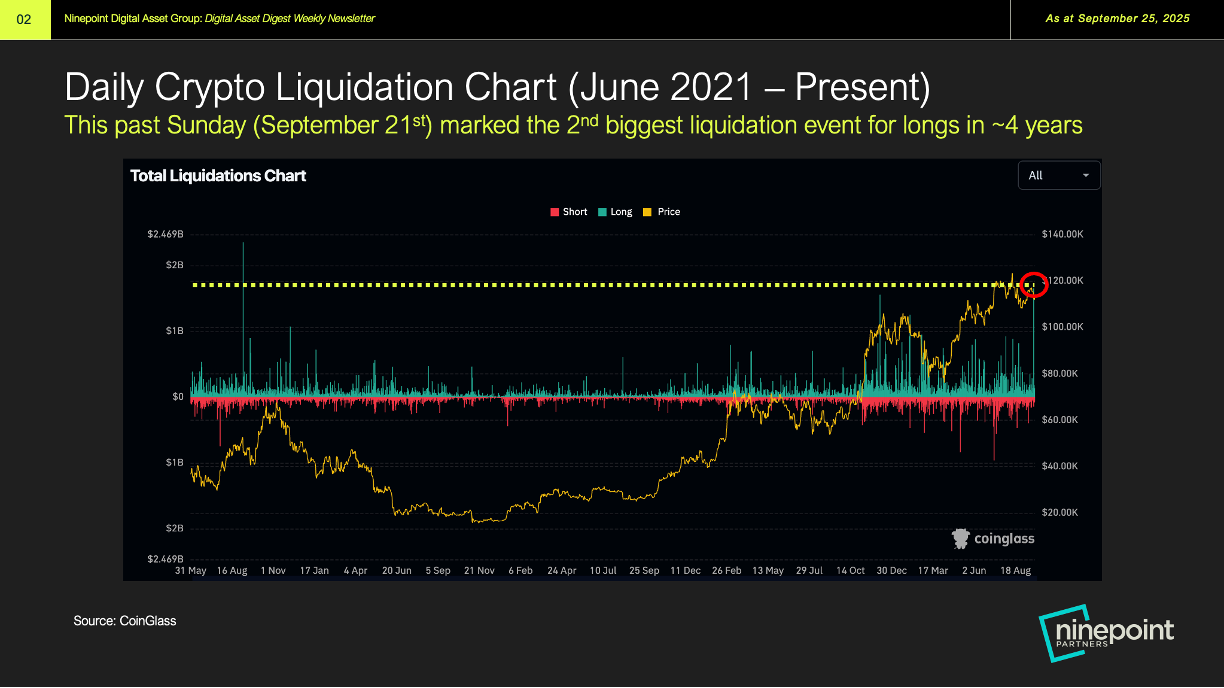
Chart 2: MASSIVE  LEVERAGE WASHOUT INITIATED CURRENT CRYPTO PULLBACK
With broader markets pushing to new all-time highs on Monday, many wondered why crypto was in the red. The answer is pretty simple: a massive leverage washout. Last Sunday, September 21st, roughly $1.65 billion worth of long positions were liquidated, the largest amount in about four years since September 2021, which sent open interest in crypto futures down from $225 billion to $205 billion and knocked nearly 5% off the total crypto market cap. Bitcoin held up relatively well, dropping just 3.5%, while Ethereum and Solana fell much harder, 8% and 10%, in line with the fact that ETH and SOL longs saw $490 million and $100 million in liquidations compared to $285 million for Bitcoin. That means this wipeout was far more altcoin-driven, with Bitcoin accounting for only 17% of total liquidations. We’ve seen this happen before in frothy periods when leverage builds up too aggressively, and while it’s painful in the short term, it’s ultimately healthy for the market over the medium and long run. Interestingly, this shakeout also comes at a time when “perp DEXs,” or decentralized exchanges offering perpetual futures trading, are one of the hottest corners of the market, led by Hyperliquid and now a newer entrant supported by Binance Founder CZ, but that’s a story for another day.
COMMENTARY & INSIGHTS