
The Map Turns Blue
The blue wave everyone talked about turned out to be a tsunami. Democrats won the midterms by a historic margin. The House was widely expected to flip, but the Senate result far exceeded expectations. Heading into Election Day, prediction markets gave Democrats only a 65% chance of winning the Senate. Instead, it was a blowout: with the races in Mississippi and Alaska still to be finalized, Democrats could end up with as many as 56 Senate seats. Places long considered Republican strongholds turned blue. Kansas elected its first Democratic senator since 1932, and Texas went blue up and down the ballot, with James Talarico becoming the first Democrat elected to the Senate from Texas since 1988. Voters sent a clear message: they want action on affordability, an end to the wars, and a slowdown in the datacenter buildout, and the Democrats will push for policy changes on all of these fronts.
Figure 1 – Senate Seats Swing to Democrats
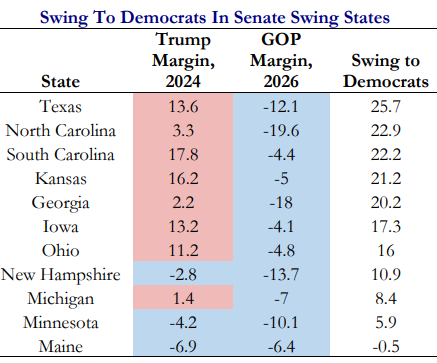
Perhaps just as notable as the changes in Washington were the governor races. Democrats flipped five governorships (Texas, Georgia, Ohio, Iowa and Nevada) and now hold 28 of the 50 governor’s offices, a majority for the first time in 16 years. Several of the flips came in key datacenter states. In Texas, Gina Hinojosa ousted Greg Abbott to become the state’s first Democratic governor since 1995, after campaigning on rising household costs and criticizing his handling of AI datacenter development. In Georgia, Keisha Lance Bottoms won, ending Republican control of the governor’s office that began in 2003. In Ohio, Amy Acton beat Trump-backed Vivek Ramaswamy to become the first Democrat elected governor there since 2006. And in Pennsylvania, Josh Shapiro won re-election by more than 20 points.
Winners and losers
The market reaction was benign at first, then violent. Initially, stocks rallied and bond yields eased as investors read the combination of gridlock and guardrails as a positive. But the recognition that the datacenter buildout now faced greater policy risk spread quickly into semiconductors, power generation and other datacenter-related companies. With a divided Washington and a changed political backdrop, some investment themes now look better placed than others. Here is how we see the winners and losers by theme:
AI and Datacenters – Datacenter-related companies were the losers this week, while the hyperscalers (the large cloud companies building the datacenters) were potential winners. The biggest reason for concern was the Democratic governor wins in key datacenter states, with Texas the main focus. Based only on datacenters already under construction, Texas represents 20% of expected net additions in 2027 and 27% in 2028. Governor-elect Gina Hinojosa has called for a moratorium on datacenter approvals until new legislation is passed, which is not likely until mid-next year. That legislation will likely include some mix of bring-your-own-power, closed-loop water, an end to subsidies and, possibly, union labor requirements. The key risks to datacenters are therefore time delays and higher costs.
Figure 2 – States Planned Capacity and Datacenter Policy (Winner in Green)
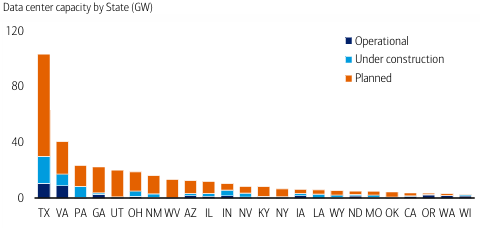
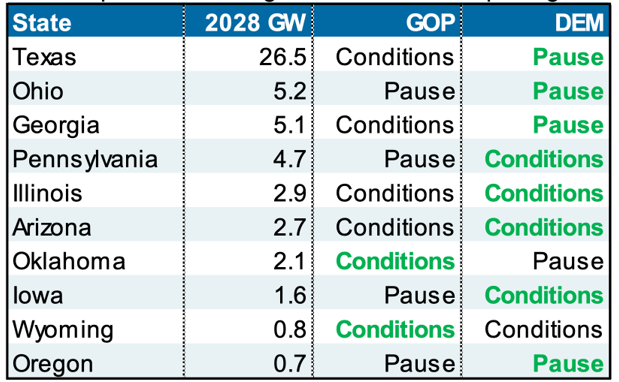
The prospect of a slower buildout hit every company tied to it this week, including semiconductors, memory and power generation. The hyperscalers held up relatively better, for two reasons. A more drawn-out buildout could ease concerns about their free cash flow (the cash left after spending on the buildout), and if computing capacity stays scarce, the capacity they already have becomes more valuable.
Health Care – Health care is a clear priority for the incoming Democratic majority, which will seek to roll back Medicaid cuts, reinstate the enhanced Affordable Care Act ("ACA") subsidies, restore withheld NIH funding, expand Medicare to include dental, hearing, and vision coverage, and pursue drug pricing reforms. The practical ceiling on all of this is significant: presidential veto power remains with Trump through January 2029, and Senate filibuster rules constrain major legislation. The more actionable near-term battlegrounds are the 2027 debt ceiling and appropriations fights over NIH and agency funding. Drug pricing, where there is some bipartisan overlap, is the area most likely to see actual movement, while major structural reform is more realistically a 2028 campaign issue.
The clearest near-term winners from a Democratic Congress are ACA exchange insurers and Medicaid-exposed managed care.
Consumer – The blue wave carries a clear affordability mandate from voters, nearly 90% of whom cited cost of living as a crucial or major concern on election day. Democrats will pursue a broad affordability agenda — covering gas and energy costs, groceries, credit card fees, SNAP restoration, child care, housing, and tariffs — but the practical ceiling is significant: presidential veto power constrains major legislation, and tariff policy in particular remains largely an executive prerogative. The most actionable near-term levers are delaying or scaling back SNAP and Medicaid cuts. On credit card fees and interchange, Democrats will generate significant headline risk but enacted caps are considered very unlikely. Housing has genuine bipartisan traction — faster permitting, FHA changes, and broader credit access — though the party remains divided on strategy.
The net takeaway is that the blue wave favours the bottom end of the K-shaped consumer over the top. For lower-income households, gasoline expenses have risen to 9.3% of household income for the lowest quintile — making any relief at the pump, an eventual end to the Iran war, and SNAP protection disproportionately impactful. For the top end of the K, the wealth-effect tailwind from the AI trade has now met a policy headwind, with datacenter-related stocks selling off sharply this week.
Active and Differentiated
For those following our work, we have been writing about market concentration, crowding into the AI buildout, and favouring differentiated sectors such as Health Care. All of these themes came to a head this week, amid continued extreme volatility in the Q3 earnings season. Given our focus on playing defense in this environment, we entered the week 18% underweight Technology in NAGF and 8% underweight in GBSL. That positioning helped us avoid the worst of the damage for our investors, including the sharp drop on Thursday.
We also added another layer of protection ahead of last week’s high-bar earnings releases. We put on option hedges, selling some upside going into earnings events and using that premium to buy downside protection. Those hedges paid off this week. They added value in both GBSL and NAGF and helped cushion the downside.
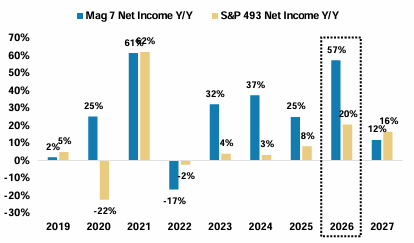
Meanwhile, we continue to look for opportunities as the market broadens out. While the precipitous drop in technology companies grabbed this week’s headlines, the S&P 500 Equal Weight Index ended the week just 3% off its all-time high. Earnings for next year are beginning to favour the “other 493” as earnings in other sectors see a pick up in growth as the AI capex beneficiaries moderate. Moreover, it is important not to lose sight of the big picture – while some volatility is normal, the 12 months post midterm elections tends to be a rewarding period to invest, with the S&P 500 having not seen a negative period in almost 90 years (since 1938).
Figure 3 - Earnings to Broaden in 2027 (LHS), S&P 500 Returns 12 Mos. Post Midterms (RHS)
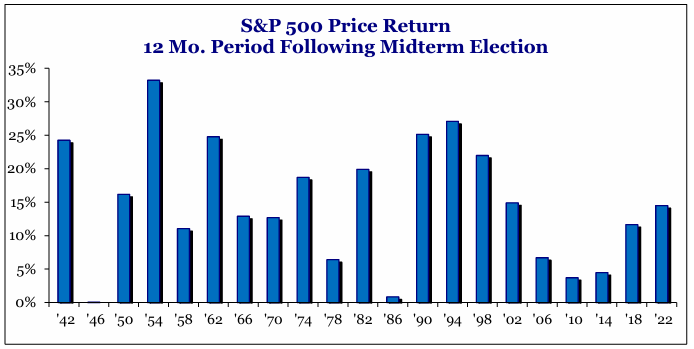
In summary, the midterms didn’t change the big picture, but they did change the balance of risks. A divided Washington should mean fewer sweeping policy swings, yet the new political backdrop adds real friction for the AI buildout, which was the most crowded corner of the market. In an environment like this, we think being selective is what gets rewarded. We will keep playing defense where crowding and valuations leave little room for error, and keep leaning into differentiated areas such as Health Care and the broader group of companies that benefit as market leadership widens. History suggests the year after a midterm election tends to reward patient investors, and our goal is to be positioned to capture that upside while still protecting on the downside.
Have a great week!
Tony, Sam & JLO


