
 July 31, 2026
Commentary




The monthly commentary discusses recent developments across the Ninepoint Diversified Bond, Ninepoint Alternative Credit Opportunities and Ninepoint Credit Income Opportunities Funds.
The fragile ceasefire between the U.S. and Iran broke in July, driving oil prices higher. The situation remains fluid, but it seems like the U.S. doesn’t want to escalate any further, given the political and economic sensitivity to gasoline prices (now over $4 a gallon nationwide). Moves in U.S. interest rates are also top of mind, with 30-year yields at their highest since 2007 (Figure 1 below). Interestingly, most of the move higher in the long bond yields hasn’t been attributable to inflation expectations (as one would expect with oil prices moving higher), but to real yields, which now sit at their highest level on record (outside of the 2008 financial crisis, which created really wonky market conditions).

And its not just 30-year bonds; 10-year, 5-year and 2-year real yields are also sitting at levels consistent with extremely tight monetary policy, last seen in 2023, and the 2006-2007 period, when the Fed Funds rate was over 5%.
So why are real yields restrictive right now? What is the bond market telling us?
To frame the discussion, think of any benchmark (2,5,7,10 & 30 year) bond yield as the sum of the expected Fed Funds Rate over that period (i.e. the long term neutral rate, or r-star), and a term premium investors ask for to compensate them for things that could change over the term of that given bond.
We do not have a definitive answer, but can offer a few thoughts.
First of all, the neutral rate is probably higher than the FOMC’s 3.1% estimate. The Fed Funds Rate today is around 3.6%, so about 0.5% above the FOMC’s estimate of neutral. But, it is hard to argue that monetary policy is restrictive if the economy is humming along, and the unemployment rate remains in the 4% range, while core inflation is stuck at ~3%. Looking at popular yield curve models, market implied long-term neutral rates are closer to 4%. In other words, a strong and resilient economy is pushing up the neutral rate, well above current Fed estimates.
Also, elevated deficits raise the equilibrium real rate needed to crowd in enough private saving to fund the government, and they mechanically increase the stock of duration the private sector has to absorb, at the exact moment the Fed (via QT) and foreign officials (per TIC data, growing slower than issuance) are both doing less of that absorption, thus increasing the term premium. Additionally, we could even argue that the hyperscaler debt binge in 2026 is exacerbating this increase in the term premium. They are price-insensitive borrowers with massive borrowing needs and favour long-term debt. Given their scale, they are also contributing to this increase in term premiums.
Higher neutral rates AND term premiums, this is the narrative the bond market is going with. At this juncture, and with what we know, what is the thesis for even higher yields, or have we peaked, and is now a good time to be adding duration?
We would argue that the "higher neutral rate" thesis might be resting on a fragile foundation. U.S. growth is increasingly a one-legged stool, relying heavily on AI capex, which could fade as real spending gets squeezed by rising input costs even as nominal spend grows. The all-in cost of debt has also increased meaningfully for hyperscalers, making the math harder for return on invested capital, which could slow spending next year. Further, the labor market is weaker than the headline unemployment rate shows. The participation rate has been shrinking rapidly (Figure 2 blow), and the household survey, which usually picks up turns in the labour market faster than the non-farm payrolls, shows a net loss of 1.8mm jobs since the start of 2026. Finally, elevated inflation is the combination of three supply shocks (tariffs, oil/Iran and AI-capex-driven input costs) rather than demand-pull, and that’s not something the FOMC has control on.
To paraphrase Chair Warsh, the bond market has been doing the heavy lifting (i.e. tightening) for the Fed, and these higher real interest rates will weigh on economic activity in the future, taking inflation back down with it.

Further on the term premium discussion, fiscal deficits are probably here to stay, but at its latest quarterly refunding announcement, the U.S. Treasury made a subtle but notable language change: it mentioned the possibility of changing (and not increasing) coupon auction sizes. We see this as a sign that Treasury Secretary Bessent might be looking at ways to reduce long-term rates by reducing the amount of long-term bonds they issue. Furthermore, as bond yields and credit spreads rise, hyperscaler capex becomes more expensive to fund, which might eventually lead to a decline in issuance. These factors point to a potential limit to the increase in term premiums.
Of course, there are also upside risks to rates, chief amongst them is renewed fears of Fed politicization, which could further erode confidence in the institution. The Governor Lisa Cook’s case is still unresolved, and Governor Barr might get in trouble for the 2023 bank failures. This administration is looking at everything they can to take control of the institution. The AI revolution could also be accelerating, with real gains in productivity showing up in economic data, reinforcing this idea that the neutral rate in the economy should be higher, not lower.
This is why we prefer to express a longer U.S. duration position through options on rates as opposed to buying outright. This offers us a margin of safety, selling out of the money put spreads to buy calls, in case the current narrative switches gears and growth concerns re-emerge. That isn’t our immediate base case, but an alternative scenario worth planning for.
Closer to home, Canadian economic data continues to outperform expectations, GDP growth for the second quarter is set to come in above 3%, while job gains continue to erode the unemployment rate, which now sits at 6.4%, from a high of 7.1% in 2025. Granted, some of this strength is catch up from very weak conditions for most of 2025, and there is still some slack in the economy, but it is nonetheless a welcome rebound, which should also make the Bank of Canada’s job a little easier, should inflation become a problem again. For now though, inflation has been extremely well behaved, with the various core metrics all decelerating even further. In our view, the path of least resistance for the BoC is to do nothing with interest rates, but if this economic strength persists, we would expect them to signal their willingness to adjust rates to the upside, at the very least taking the overnight rate from 2.25% back to the mid-point of what they consider neutral (i.e. 2.75% to 3%). Relative to the U.S., where we see the selloff as overdone, we have kept our Canadian rate duration low, preferring bonds with 5-years to maturity and lower.
A quick word on credit markets, it is still all about hyperscaler supply, which is a microcosm on its own, but with influence and ramifications for all credit. Most recently post Q2 earnings, Alphabet issued $25bn of debt in the U.S. market, much wider than their existing bonds, taking their whole credit curve wider. This is the kind of market we are in, and that’s why issuer selection is so important right now. Figure 3 below makes this point clear, AI related debt has materially underperformed non-AI related debt in the U.S. corporate bond market. The same is happening here in Canada.

With the announcement by META that they will build their first Canadian datacenter for C$14bn, we expect them to eventually issue in the Canadian bond market. This might be a bit much for our market to absorb, and we therefore continue to avoid this space and other related bonds in the long end, which might see some pressure from elevated 30-year issuance. Issuer and security selection are increasingly important in this market.
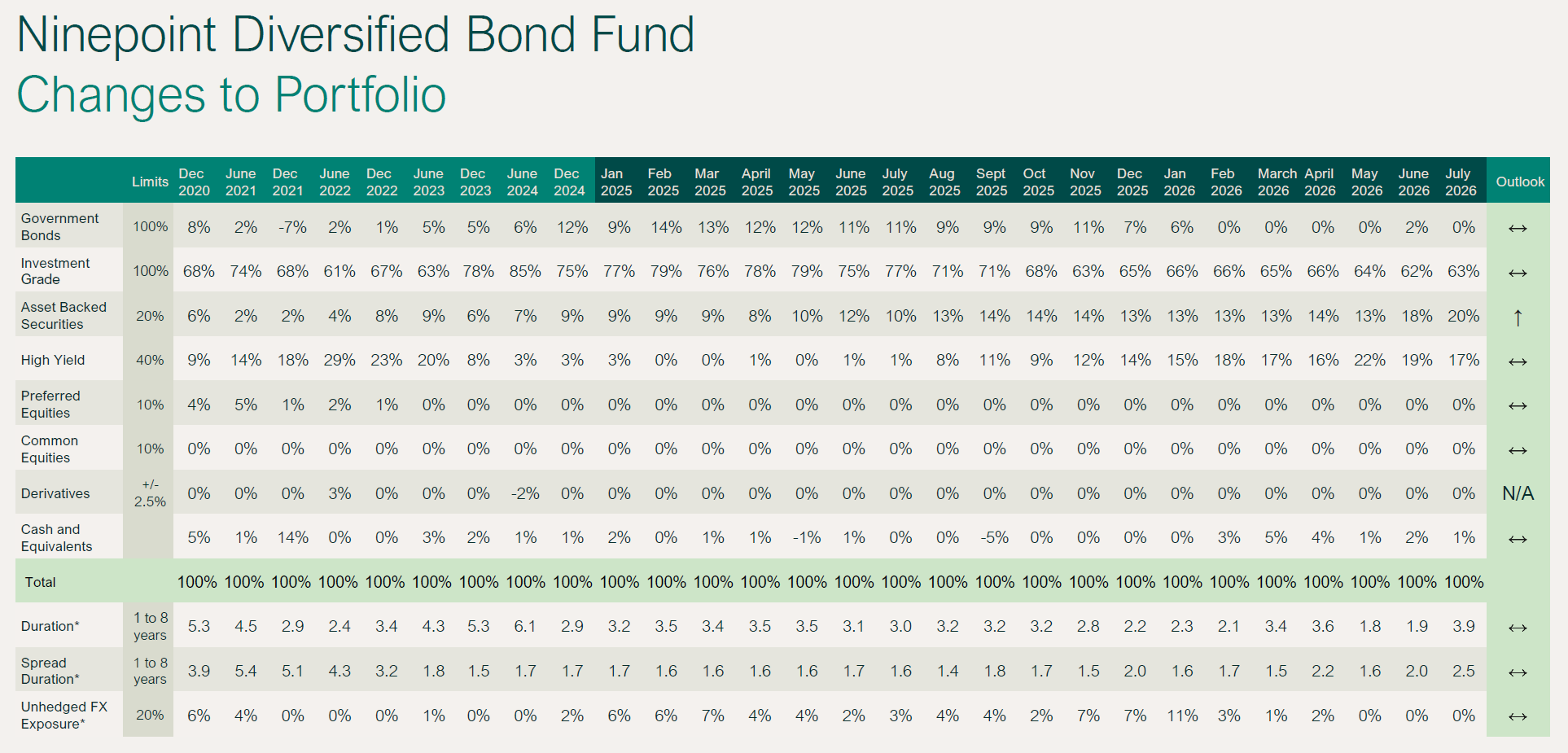
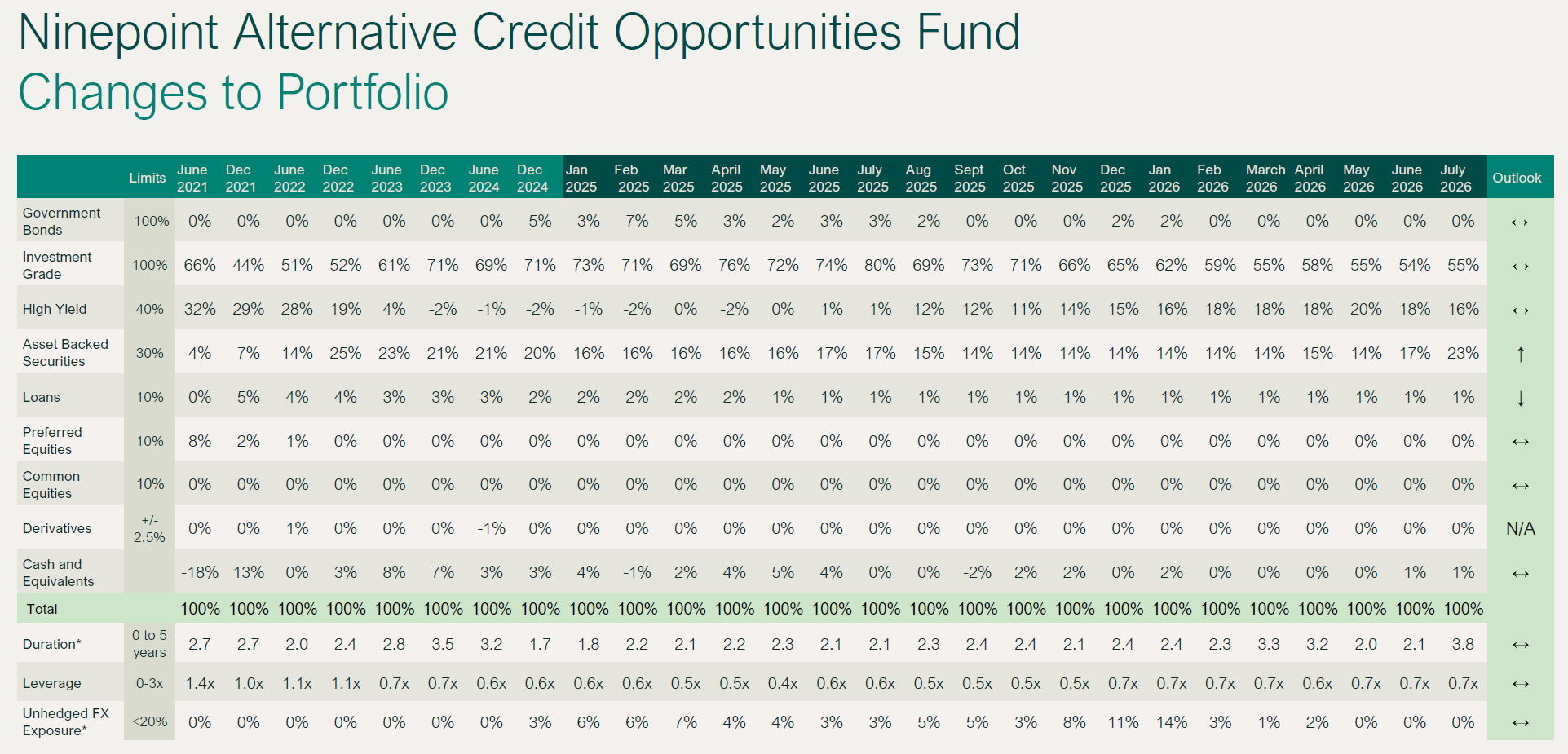
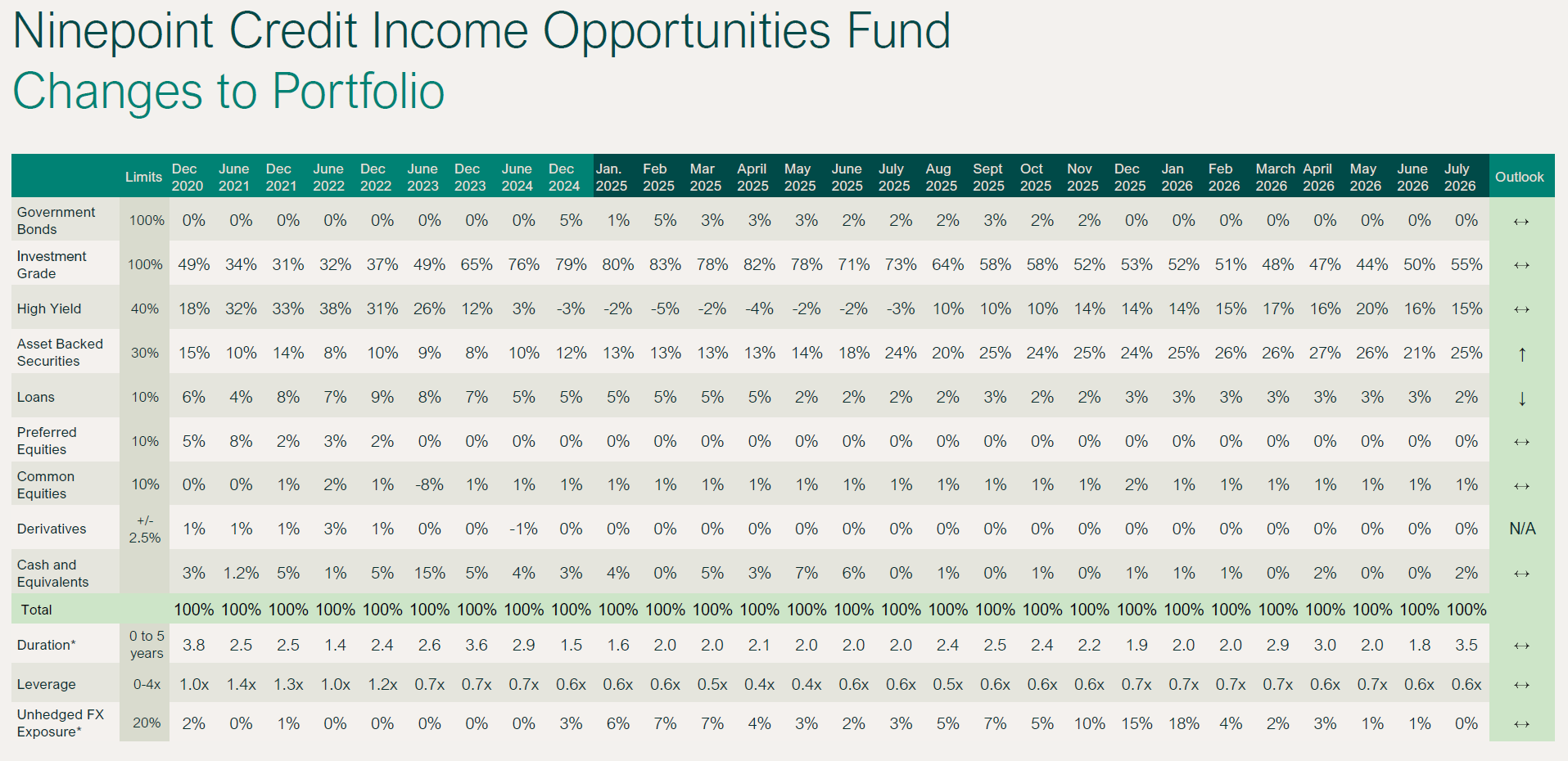
Table 1 below shows the various statistics and exposures as of July month end. As discussed above, following the selloff in U.S. rates to levels last seen in 2007, we increased duration to just under 4 years (from around 2 years last month) using options. Credit duration has also moved up a little, as we rolled out of some CDX credit hedges and into outright short positions in hyperscaler bonds.
Canadian economic data continues to surprise to the upside, while U.S. data is surprising to the downside, further reinforcing the case for a fully hedged position on the US Dollar.
Table 1: Fund Characteristics as of July 31 2026.

Conclusion
All-in yields in the portfolios remain extremely attractive, and constitute the first line of defence for investors. Our funds have navigated this tricky environment quite well year-to-date, maintaining our relative performance and avoiding large drawdowns. That’s the play book, we are 100% focused on what’s going on and stand ready to react to pitfalls and opportunities.
Have a great summer,
Mark, Etienne & Nick
As always, please feel free to reach out to your product specialist if you have any questions.
Ninepoint Diversified Bond Fund
NINEPOINT DIVERSIFIED BOND FUND - COMPOUNDED RETURNS¹ AS OF JULY 31, 2026 (SERIES F NPP118) | INCEPTION DATE: AUGUST 5, 2010
1M |
YTD |
3M |
6M |
1YR |
3YR |
5YR |
10YR |
15YR |
Inception |
|
|---|---|---|---|---|---|---|---|---|---|---|
Fund |
-0.39% |
1.06% |
0.09% |
0.61% |
3.02% |
5.85% |
1.56% |
2.70% |
3.15% |
3.51% |
Click for larger image
Ninepoint Alternative Credit Opportunities Fund
NINEPOINT ALTERNATIVE CREDIT OPPORTUNITIES FUND - COMPOUNDED RETURNS¹ AS OF JULY 31, 2026 (SERIES F NPP931) | INCEPTION DATE: APRIL 30, 2021
1M |
YTD |
3M |
6M |
1YR |
3YR |
5YR |
Inception |
|
|---|---|---|---|---|---|---|---|---|
Fund |
-0.26% |
1.67% |
0.75% |
1.16% |
3.79% |
6.81% |
2.74% |
2.88% |
Source: Ninepoint Partners. Subject to change without notice.
Click for larger image
Ninepoint Credit Income Opportunities Fund
NINEPOINT CREDIT INCOME OPPORTUNITIES FUND - COMPOUNDED RETURNS¹ AS OF JULY 31, 2026 (SERIES F NPP507) | INCEPTION DATE: JULY 1, 2015
1M |
YTD |
3M |
6M |
1YR |
3YR |
5YR |
10YR |
Inception |
|
|---|---|---|---|---|---|---|---|---|---|
Fund |
-0.36% |
1.31% |
0.45% |
1.00% |
3.79% |
6.56% |
3.47% |
5.00% |
4.81% |
Click for larger image