

How high yield can make investment risk easier to overlook.
A monthly distribution can make almost any investment feel more sensible.
That is especially true when the investment is attached to a story investors already want to believe in. Artificial intelligence. Space exploration. Nuclear power. Digital infrastructure. Energy security. The next great technology platform. The next household-name IPO.
Add a double-digit indicated yield to that story, package it in an ETF, and suddenly an investment that might otherwise feel speculative can start to feel like a disciplined income strategy.
That is the behavioural risk of thematic income ETFs.
To be clear, thematic income ETFs can play a useful role in a portfolio. Many investors want exposure to long-term growth themes, but they also want cash flow. Covered-call strategies can help convert some of the uncertainty around a stock or sector into option income. For investors who understand the trade-offs, that can be a perfectly reasonable approach.
The danger begins when the monthly distribution becomes the whole story.
A traditional income investor may look at a covered-call ETF linked to a hot theme and see the familiar language of yield, cash flow and monthly payments. But underneath the hood, the risk may look very different from a bond fund, dividend portfolio or broad-market income ETF. The underlying exposure may be concentrated in a single stock, a narrow sector, or a group of companies with high valuations, uncertain earnings and wide price swings.
In other words, the wrapper says “income,” but the engine may still be growth, momentum or speculation.
This distinction matters because investors tend to treat income differently from capital gains. A monthly distribution feels tangible. It lands in the account. It can be spent, reinvested or used to fund retirement needs. That regular cash flow can create a sense of comfort and control, even when the underlying asset is highly volatile.
Behaviourally, this can lead to a subtle reframing. Instead of asking, “Do I want to take concentrated exposure to this high-volatility theme?” investors may ask, “Would I like to receive a high monthly yield from this exciting opportunity?” Those are very different questions.
The first question focuses on risk. The second focuses on reward.
Covered-call ETFs can also create a second behavioural trap: the feeling that volatility is being solved rather than monetized. In a covered-call strategy, the fund typically owns a stock or portfolio of stocks and sells call options against some or all of that exposure. The option premium collected can support distributions. When expected volatility is high, option premiums can be richer.
But richer premiums are not free money. They are compensation for taking the other side of uncertainty. The market is not offering high option income because the outcome is safe. It is offering high option income because the range of possible outcomes is wide.
That range cuts both ways.
If the underlying stock or sector falls sharply, the option income may help cushion the decline, but it may not come close to offsetting the full loss. A high distribution can coexist with negative total return. Investors who focus only on the cash paid out may miss what is happening to the value of their original capital.
At the same time, if the underlying stock rallies sharply, the covered-call strategy may not fully participate. The calls sold by the fund can cap some of the upside. That is the trade-off: more cash flow today, potentially less participation in a powerful rally tomorrow.
For income investors, this is not necessarily a problem. Many are willing to give up some upside in exchange for regular cash flow. But it becomes a problem if the investor believes they are getting both the full excitement of the theme and the full benefit of the yield.
They usually are not.
This is especially important in an IPO-driven market. When a high-profile company goes public, investor attention can be intense. The company may have a powerful brand, a visionary founder, a massive addressable market and a compelling long-term narrative. If options become available and ETFs are launched around the stock or theme, the income opportunity can look attractive very quickly.
But a newly public stock may also have limited trading history, uncertain public-market valuation, restricted float, lockup expiries ahead, and intense sentiment-driven price action. For a covered-call ETF, that volatility can support income. For the investor, it can also introduce meaningful drawdown risk.
The key is to separate three ideas that often get blended together.
- First, do you believe in the theme?
- Second, do you want exposure to the underlying asset?
- Third, is a covered-call ETF the right way to access that exposure?
An investor may believe artificial intelligence will reshape the economy and still decide that a narrow AI income ETF is too concentrated. An investor may believe a newly public space company has extraordinary long-term potential and still prefer to wait for a broader, more diversified strategy. An investor may like the distribution profile of a covered-call ETF and still limit it to a satellite position rather than a core income holding.
That is not being timid. That is matching the tool to the job.
For most income investors, the practical question is not whether thematic income ETFs are “good” or “bad.” It is whether the role they play in the portfolio is clearly understood. A broad covered-call ETF on a major equity index may serve one purpose. A single-stock or narrow-theme covered-call ETF tied to a viral IPO story may serve another. Both may produce income, but they do not carry the same risks.
Before buying a thematic income ETF, investors should ask a few important questions:
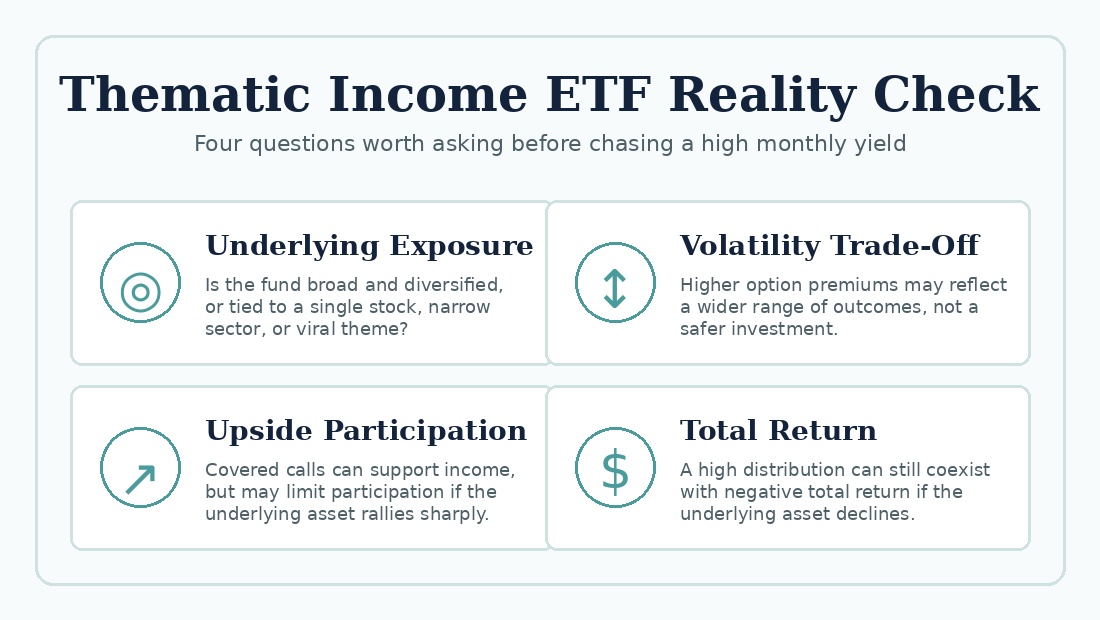
What exactly is the fund exposed to? How concentrated is that exposure? How much upside is being sold away through the options strategy? Is the distribution mostly option income, dividends, return of capital, or some combination? What would happen if the underlying stock fell 30%? Would the fund still make sense if the headline yield declined? Is this a core income allocation, or a speculative satellite with monthly cash flow?
The final question may be the most important: am I buying income, or am I buying the story?
There is nothing wrong with owning a story, as long as you know that is what you are doing. Great companies and transformative themes can create enormous value over time. But a high distribution does not make a risky asset safe. It only changes the way the risk shows up.
When yield goes viral, discipline matters more, not less.
Because in the end, income is not just about how much cash an investment pays. It is about what risk had to be taken to produce that cash — and whether that risk belongs in your portfolio.