
Commentary
Print/PDF Print/PDF Subscribe

Ninepoint Fixed Income Strategy

Fixed Income Strategy - June 2026
Key Takeaways
  • Both the Fed and BoC have been on hold so far in 2026, but Canada has massively outperformed the U.S. bond market.
  • Canadian economic activity seems to have troughed, and therefore this outperformance vs the U.S. cannot last. We see risk to the upside in rates and are positioned accordingly.
  • There is no reprieve in the corporate bond market. New issues are up 60% and 30% vs last year in Canada and the U.S., respectively.
  • But despite this, credit spreads remain close to all time tights. We actively avoid issuance heavy sectors and issuers given they tend to underperform.

The monthly commentary discusses recent developments across the Ninepoint Diversified BondNinepoint Alternative Credit Opportunities and Ninepoint Credit Income Opportunities Funds.

What a year it has been so far. We are now past the mid-point of 2026, and as we typically do, we will recap the year so far, and offer our thoughts for the second half.

First off, it is always informative to look at the behavior of North American interest rates and credit spreads, the two main drivers of volatility in our funds. Table 1 below shows, for both Canada and the U.S., the year-to-date change in rates across the curve, along with the major credit indices (IG and HY). Despite both central banks being on hold this year (i.e. no change in the overnight rate), we had a lot of rates volatility. 

Source: Bloomberg

Of course, the increase in oil prices due to the war in Iran had its bearish impact on rates, but with crude prices down meaningfully from the peak, there is clearly something else going on, otherwise, why would U.S. 2-year rates still be up by 70bps (and 4x more than here in Canada)?  

We believe that the answer is inflation and economic growth divergence. Thinking back to the start of 2026, economic growth in Canada was muted (we even had two consecutive quarters, 2025Q4 and 2026Q1, of mildly negative growth), the unemployment rate was flirting with 7%, and inflation was at the 2% target. Notwithstanding the war in Iran and the oil shock, the Bank of Canada (BoC) would have probably cut interest rates in the spring. Therefore, the message from the BoC has been consistently clear, they are in no rush to increase rates and can be patient. The bond market has finally heard them, and that is why rates have behaved so well, with very modest net changes in interest rates so far in 2026 across the curve. 

Now, the situation in the U.S. is completely different. Between fiscal stimulus (remember the OBBB?), the AI CAPEX boom, unemployment at 4.2% and core inflation still stuck above 3%, there is a strong case to be made for interest rate hikes, even with oil prices now back in the $80 range. Additionally, the new FOMC Chair, Kevin Warsh, took advantage of his first meeting at the helm of the Fed to firmly establish his inflation fighting credentials, repeatedly mentioning inflation as a choice and a direct consequence of monetary policy decisions. Now, it is unlikely that we see a Fed rate hike in July, but sometime in the Fall is certainly on the table if core inflation remains elevated and starts broadening out due to widespread price pressures. We believe that U.S. hikes late 2026 are certainly a possibility, and that, barring a negative growth surprise, U.S. interest rates are not likely to go much lower from here. 
Click for larger image
Source: Bloomberg, as of July 7th, 2026.

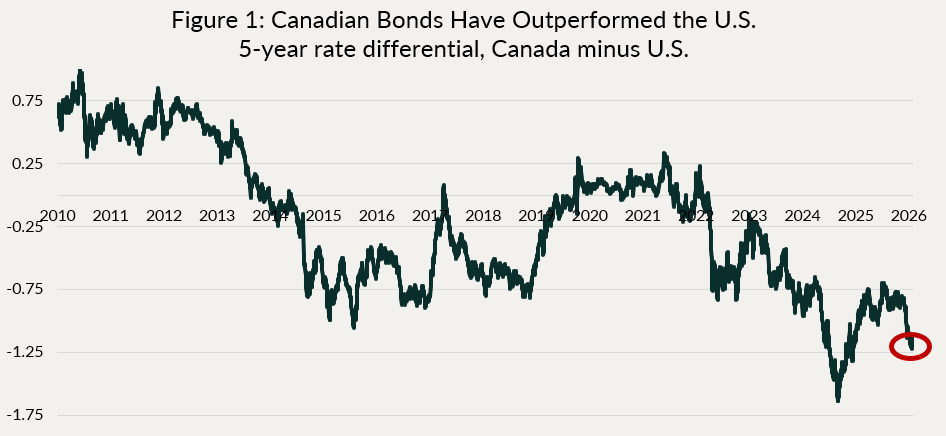
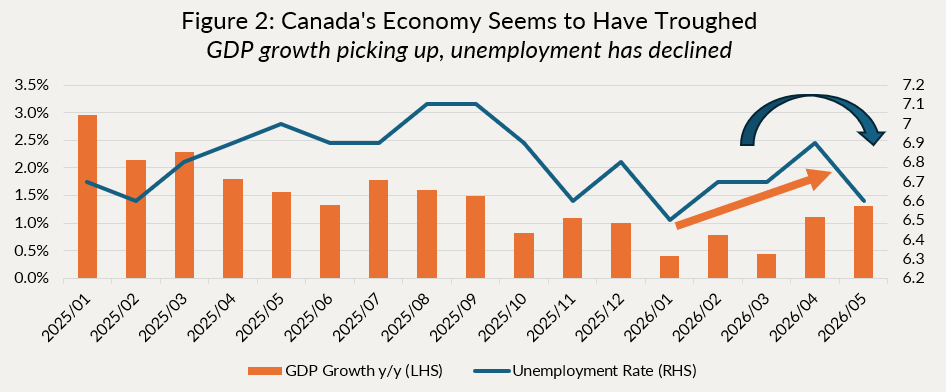
This economic divergence between Canada and the U.S. has now pushed interest rate differentials to extremes, just like last year during the worst of the trade war angst (Figure 1 above shows the difference between 5-year rates in Canada and the U.S.). That is one of the main reason the Canadian dollar has performed so poorly year-to-date versus the Greenback (-3.32%). But, in recent months, we have seen green shoots in the Canadian economic data, which shows signs of bottoming out (Figure 2). Unemployment has declined in May on the back of strong full-time payrolls, and GDP growth is broadening out. Therefore, we believe that the outperformance of Canadian bonds vs U.S. bonds has run its course as we see risks to the upside to Canadian data. But, unlike last year where this gap was resolved by a U.S. bond rally, we believe that this year, given better data, we could see the market price-in a few BoC rate hikes late this year or early next year, pressuring bond yields higher. 
Click for larger image
Source: Statscan

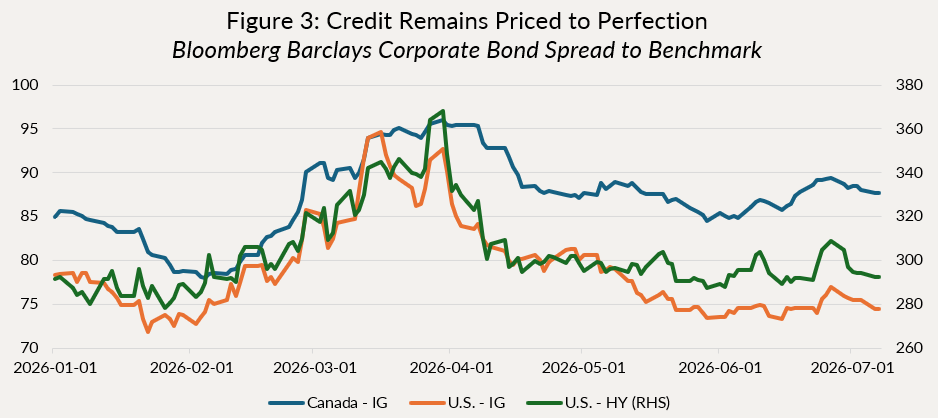
Credit markets, just like equities, continue to be buoyant. Yes, we saw some weakness in February centered around software firms and private credit exposure, quickly followed by a general risk off mood spurred by the war in Iran, but that has mostly reversed. As shown in Figure 3 below, credit spreads across North America remain right around the year’s (and multi-decades) tights.  
Click for larger image
Source: Bloomberg

Under the surface, there is more dispersion, as some sectors remain weak due to record issuance (AI datacenters and tech) and ongoing credit concerns (BDC, software, consumer lending and lower quality high yield). Nonetheless, there remains a seemingly insatiable appetite for anything with a yield on it, and selloffs are quickly bought. 

2026 is on track to break issuance records; in Canada, we are up 60% versus the same time last year, and in the U.S. about 30%. So far, the market has been able to absorb all this paper quite well, but each new mega-deal is taking longer and longer to digest. Given the preference of some of these issuers for long term bonds (10, 30, 40yrs), we have seen credit curves steepen materially. We continue to avoid these sectors or points on the curve where we think pressure will continue to build, as demand for funding by AI companies shows no sign of slowing down. 

Overall, we remain cautious on credit, preferring to keep some powder dry. We like short duration investment grade bonds with yields around 4%, corporate hybrids, which yield anywhere between 4% and 7%, and Asset Backed Securities (ABS), where we have been adding. Canadian ABS is one of the few corners of the credit markets where we can find great relative value and attractive risk reward opportunities. We participated in several transactions, spanning collateral types like commercial mortgages, secured consumer loans, car fleets and credit cards.  

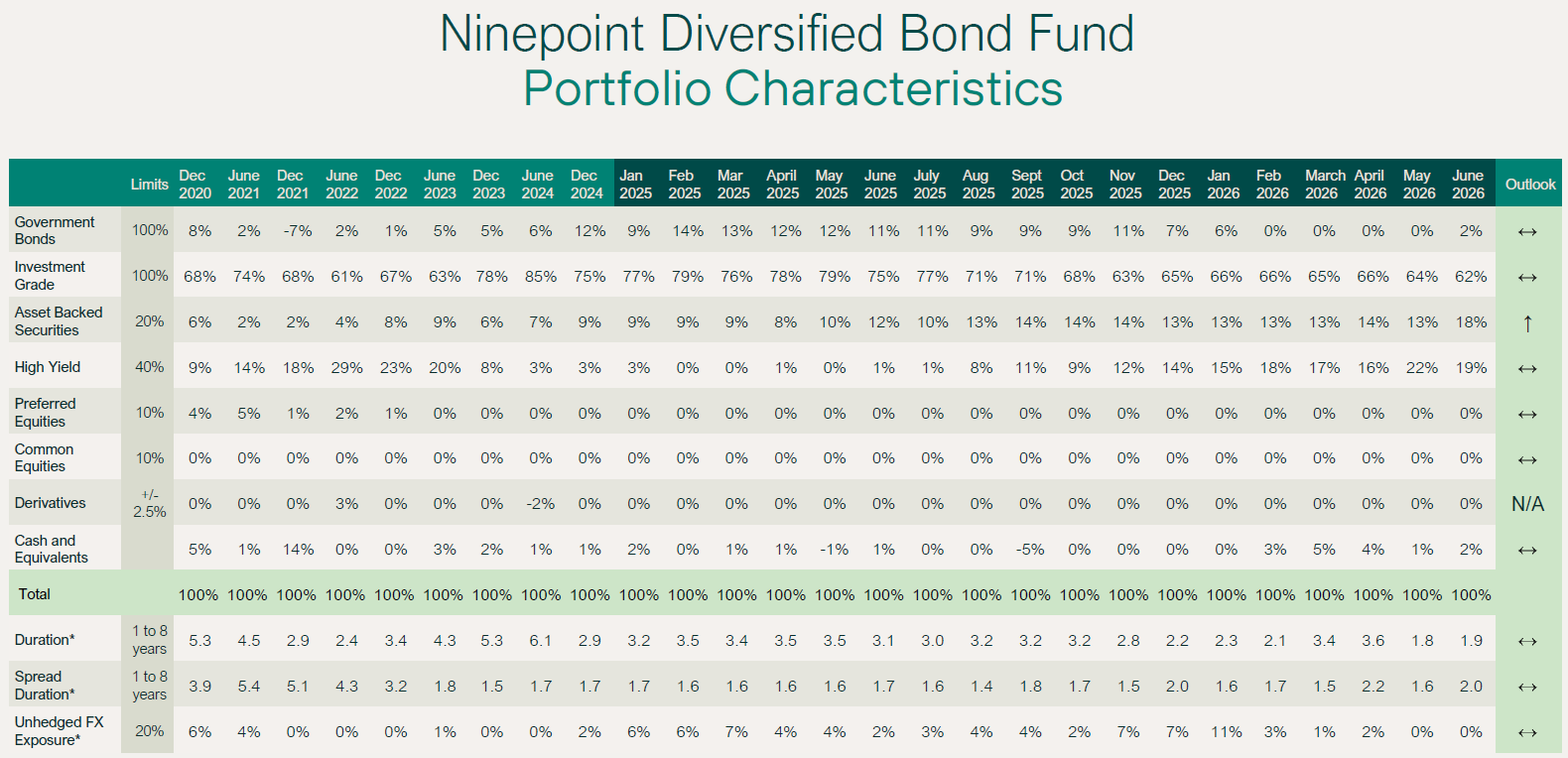
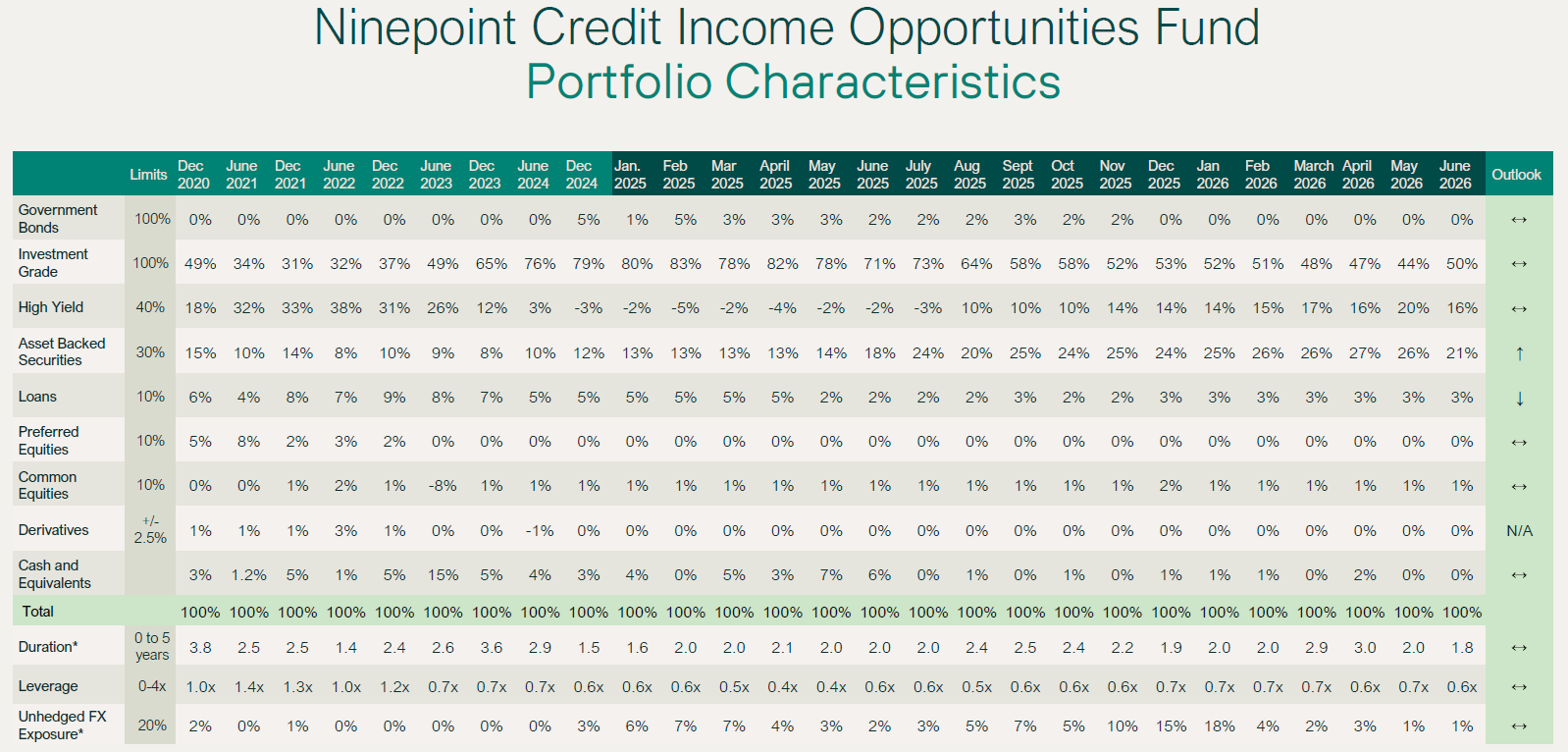
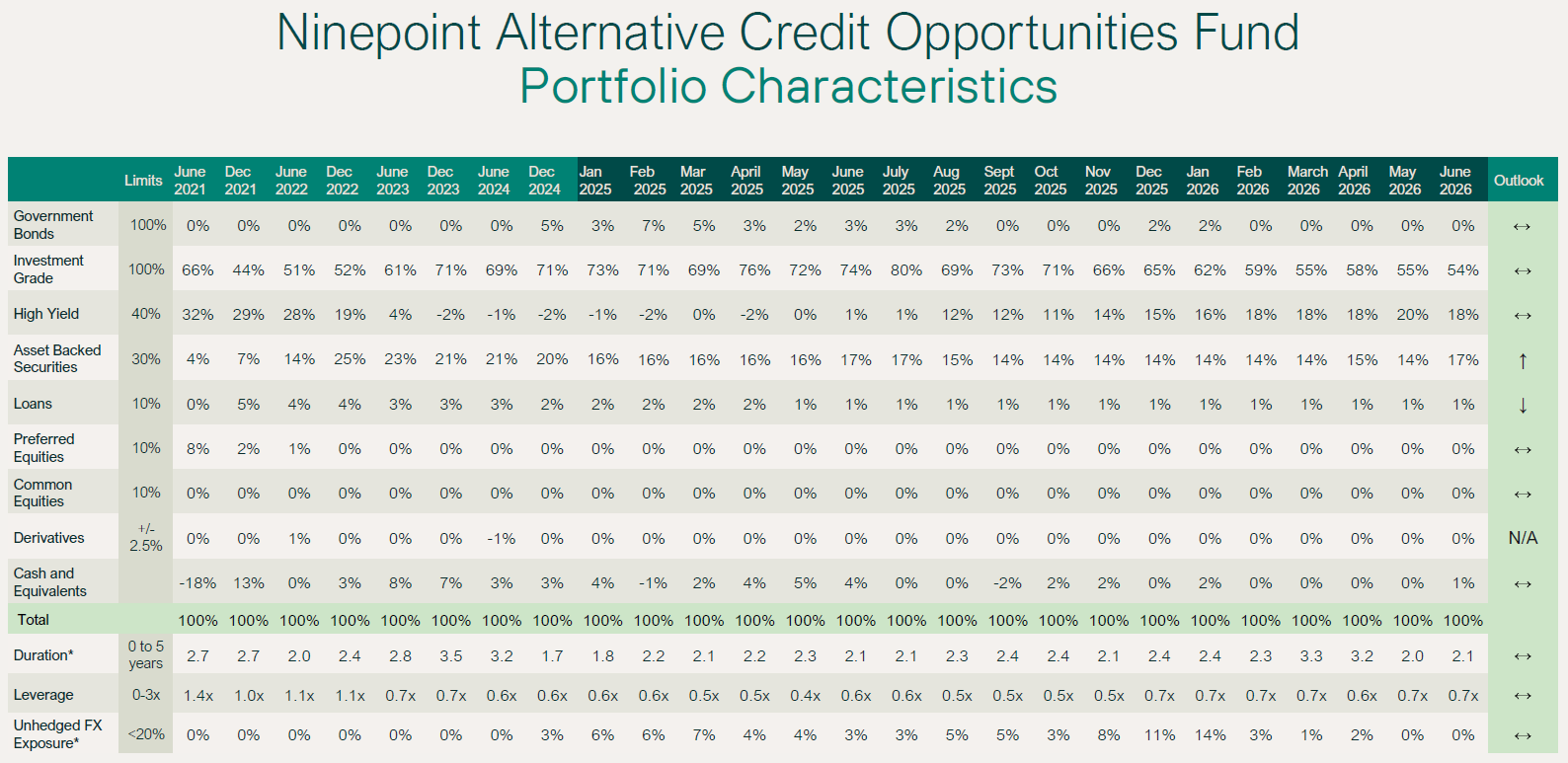
Table 2 below shows the various statistics and exposures as of June month end. Our duration is at a comfortable 2 years, while spread/credit duration remained very low, due to the impact of credit hedges and our preference for short dated bonds. Leverage is slightly higher in NACO than Credit Ops, mostly due to a large maturity we have yet to backfill. Given how cheap credit hedges are right now, we are staying fully invested, while layering this extra protection. We see this as a good way to maximize income while keeping a very defensive posture. 

If Canadian economic data starts to surprise to the upside, the Loonie could start clawing back some of the year-to-date losses. We remain fully hedged on our U.S. dollar exposure.

Conclusion

We are always trying to maximize income, while managing two main sources of risk: interest rate and credit risk. At this juncture, our portfolios yield between 5% and 6%, with very limited net exposure to both duration and credit duration, as we see risks to the upside to rates (particularly Canada) and credit spreads (still close to all time lows). This is a tricky environment, so better to continue to be patient and wait for better risk-reward before dialing exposure back up. 

Until next month,

Mark, Etienne & Nick

As always, please feel free to reach out to your product specialist if you have any questions.

Ninepoint Diversified Bond Fund

NINEPOINT DIVERSIFIED BOND FUND - COMPOUNDED RETURNS¹ AS OF JUNE 30, 2026 (SERIES F NPP118) | INCEPTION DATE: AUGUST 5, 2010

1M

YTD

3M

6M

1YR

3YR

5YR

10YR

15YR

Inception

Fund

0.31%

1.45%

0.79%

1.45%

3.60%

5.91%

1.81%

2.88%

3.24%

3.55%

Click for larger image
Source: Ninepoint Partners. Subject to change without notice.
Ninepoint Alternative Credit Opportunities Fund

NINEPOINT ALTERNATIVE CREDIT OPPORTUNITIES FUND - COMPOUNDED RETURNS¹ AS OF June 30, 2026 (SERIES F NPP931) | INCEPTION DATE: APRIL 30, 2021

1M

YTD

3M

6M

1YR

 3YR

5YR

Inception

Fund

0.49%

1.94%

1.34%

1.94%

4.60%

7.02%

2.89%

2.98%

Source: Ninepoint Partners. Subject to change without notice.

Click for larger image

Ninepoint Credit Income Opportunities Fund

NINEPOINT CREDIT INCOME OPPORTUNITIES FUND - COMPOUNDED RETURNS¹ AS OF JUNE 30, 2026 (SERIES F NPP507) | INCEPTION DATE: JULY 1, 2015

1M

YTD

3M

6M

1YR

3YR

5YR

10YR

Inception

Fund

0.51%

1.67%

1.20%

1.67%

4.56%

6.88%

3.64%

5.21%

4.89%

Click for larger image
Source: Ninepoint Partners. Subject to change without notice.

Historical Commentary

View All
  • Ninepoint Fixed Income Strategy
    For those that are counting, it has now been (at the time of writing) the 38th time that we “have a deal” with Iran. Granted, this time it does feel like we are getting close to an interim agreement for a ceasefire and to reopen the Strait of Hormuz, with a 60-day timeline to resolve the thornier issues, with Iran’s nuclear program the main sticking point.
    Fixed Income
  • Ninepoint Fixed Income Strategy
    Another year, another set of unexpected challenges. This time it’s not Liberation Day and a global trade war, but instead a real war in the Middle East.
    Fixed Income
  • Ninepoint Fixed Income Strategy
    In February, the release of certain AI tools led to doubts about the business model of many software companies. Could AI simply replace their products quickly and much more cheaply? Their stocks fell, and with that their bonds, as well.
    Fixed Income
  • Ninepoint Fixed Income Strategy
    We’re only one month into 2026, and already it feels like a long year! There are no shortages of headlines to keep us all on the edge of our seats. Separating the wheat from the chaff, what really matters for fixed income investors this year will revolve around what central banks do (or don’t do), and how risk assets, more specifically credit, behave.
    Fixed Income
  • Ninepoint Fixed Income Strategy
    Despite all the rhetoric coming out of Washington, 2025 turned out to be a great year for risky assets. Global equities finished the year close to all-time highs and corporate credit spreads rallied across the developed world.
    Fixed Income
  • Ninepoint Fixed Income Strategy: 2026 Outlook
    It certainly felt like 2025 was a very, very long year. We will go into the details of our performance attribution within the coming December commentary. For now our commentary will focus on our 2026 outlook. We will start with our overall macro and central bank view, followed by our thoughts around credit markets, concluding with a discussion on the various risks to our outlook, and how we are positioning the portfolios for potential opportunities and risks.
    Fixed Income
  • Ninepoint Fixed Income Strategy
    As was widely expected, both the Bank of Canada (BoC) and the Federal Reserve (Fed) cut interest rates for a second consecutive meeting
    Fixed Income
  • Ninepoint Fixed Income Outlook
    In this month’s Fixed Income Video Preview, Portfolio Manager Etienne Bordeleau highlights the key themes from our full written October strategy commentary — including diverging central bank paths, rising funding pressures in U.S. credit markets, and what these shifts mean for positioning across our fixed income portfolios.
    Fixed Income
    Credit
  • Ninepoint Fixed Income Outlook
    In this month's update, Etienne Bordeleau-Labrecque, Vice President & Portfolio Manager at Ninepoint Partners, previews key insights from our September fixed income commentary. In this update, Etienne discusses why recent data from both the Bank of Canada and the U.S. Federal Reserve paint a complex picture for the months ahead.
    Fixed Income
    Credit
  • Ninepoint Fixed Income Strategy
    As was widely expected, both the Bank of Canada (BoC) and the Federal Reserve (Fed) cut interest rates by 25bps at their September meetings, restarting the rate cut cycle.
    Fixed Income
  • Ninepoint Fixed Income Outlook
    In this month's update, Etienne Bordeleau-Labrecque, Vice President & Portfolio Manager at Ninepoint Partners, previews key insights from our latest fixed income commentary, focusing on the rapid deterioration in North American labour markets, the outlook for central bank rate cuts, and how we are positioning across our fixed income portfolios.
    Fixed Income
    Credit
  • Ninepoint Fixed Income Strategy
    The economic weakness we saw in July continued in August, particularly in the labour market. In Canada and the U.S., the unemployment rate is now making new cycle highs.
    Fixed Income

Ninepoint Diversified Bond Fund returns and fund details are a) based on Series F units; b) net of fees; c) annualized if period is greater than one year; d) as at 6/30/2026. Ninepoint Credit Income Opportunities Fund returns and fund details are a) based on Class F units; b) net of fees; c) annualized if period is greater than one year; d) as at 6/30/2026. Ninepoint Alternative Credit Opportunities Fund returns and fund details are a) based on Class F units; b) net of fees; c) annualized if period is greater than one year; d) as at 6/30/2026.

The Risks associated with investing in a Fund depend on the securities and assets in which the Funds invests, based upon the Fund's particular objectives. There is no assurance that any Fund will achieve its investment objective, and its net asset value, yield and investment return will fluctuate from time to time with market conditions. There is no guarantee that the full amount of your original investment in a Fund will be returned to you. The Funds are not insured by the Canada Deposit Insurance Corporation or any other government deposit insurer. Please read a Fund's prospectus or offering memorandum before investing.

Ninepoint Credit Income Opportunities Fund is offered on a private placement basis pursuant to an offering memorandum and are only available to investors who meet certain eligibility or minimum purchase amount requirements under applicable securities legislation. The offering memorandum contains important information about the Funds, including their investment objective and strategies, purchase options, applicable management fees, performance fees, other charges and expenses, and should be read carefully before investing in the Funds. Performance data represents past performance of the Fund and is not indicative of future performance. Data based on performance history of less than five years may not give prospective investors enough information to base investment decisions on. Please contact your own personal advisor on your particular circumstance. This communication does not constitute an offer to sell or solicitation to purchase securities of the Fund. 

Ninepoint Partners LP is the investment manager to the Ninepoint Funds (collectively, the “Funds”). Commissions, trailing commissions, management fees, performance fees (if any), other charges and expenses all may be associated with mutual fund investments. Please read the prospectus carefully before investing. The indicated rate of return for series F units of the Fund for the period ended 6/30/2026 is based on the historical annual compounded total return including changes in unit value and reinvestment of all distributions and does not take into account sales, redemption, distribution or optional charges or income taxes payable by any unitholder that would have reduced returns. Mutual funds are not guaranteed, their values change frequently and past performance may not be repeated. The information contained herein does not constitute an offer or solicitation by anyone in the United States or in any other jurisdiction in which such an offer or solicitation is not authorized or to any person to whom it is unlawful to make such an offer or solicitation. Prospective investors who are not resident in Canada should contact their financial advisor to determine whether securities of the Fund may be lawfully sold in their jurisdiction.

The opinions, estimates and projections (“information”) contained within this report are solely those of Ninepoint Partners LP and are subject to change without notice. Ninepoint Partners makes every effort to ensure that the information has been derived from sources believed to be reliable and accurate. However, Ninepoint Partners assumes no responsibility for any losses or damages, whether direct or indirect, which arise out of the use of this information. Ninepoint Partners is not under any obligation to update or keep current the information contained herein. The information should not be regarded by recipients as a substitute for the exercise of their own judgment. Please contact your own personal advisor on your particular circumstances.

Views expressed regarding a particular company, security, industry or market sector should not be considered an indication of trading intent of any investment funds managed by Ninepoint Partners LP. Any reference to a particular company is for illustrative purposes only and should not to be considered as investment advice or a recommendation to buy or sell nor should it be considered as an indication of how the portfolio of any investment fund managed by Ninepoint Partners LP is or will be invested.

Ninepoint Partners LP and/or its affiliates may collectively beneficially own/control 1% or more of any class of the equity securities of the issuers mentioned in this report. Ninepoint Partners LP and/or its affiliates may hold short position in any class of the equity securities of the issuers mentioned in this report. During the preceding 12 months, Ninepoint Partners LP and/or its affiliates may have received remuneration other than normal course investment advisory or trade execution services from the issuers mentioned in this report.